


Picture two schools.
School A occupies four floors of a building on a busy road, with a rooftop that doubles as the “sports ground.” School B sits on ten acres of open, green land, with separate zones for younger children, sports fields, and quiet corners to sit under a tree.
Both call themselves “CBSE schools with excellent facilities” on their websites. Only one of them actually gives your child room to run, breathe, and be a child between lessons.
If you’re searching from Kengeri, Uttarahalli, RR Nagar, or anywhere along the Mysore Road stretch, this comparison is not hypothetical. It’s the exact decision in front of you right now.
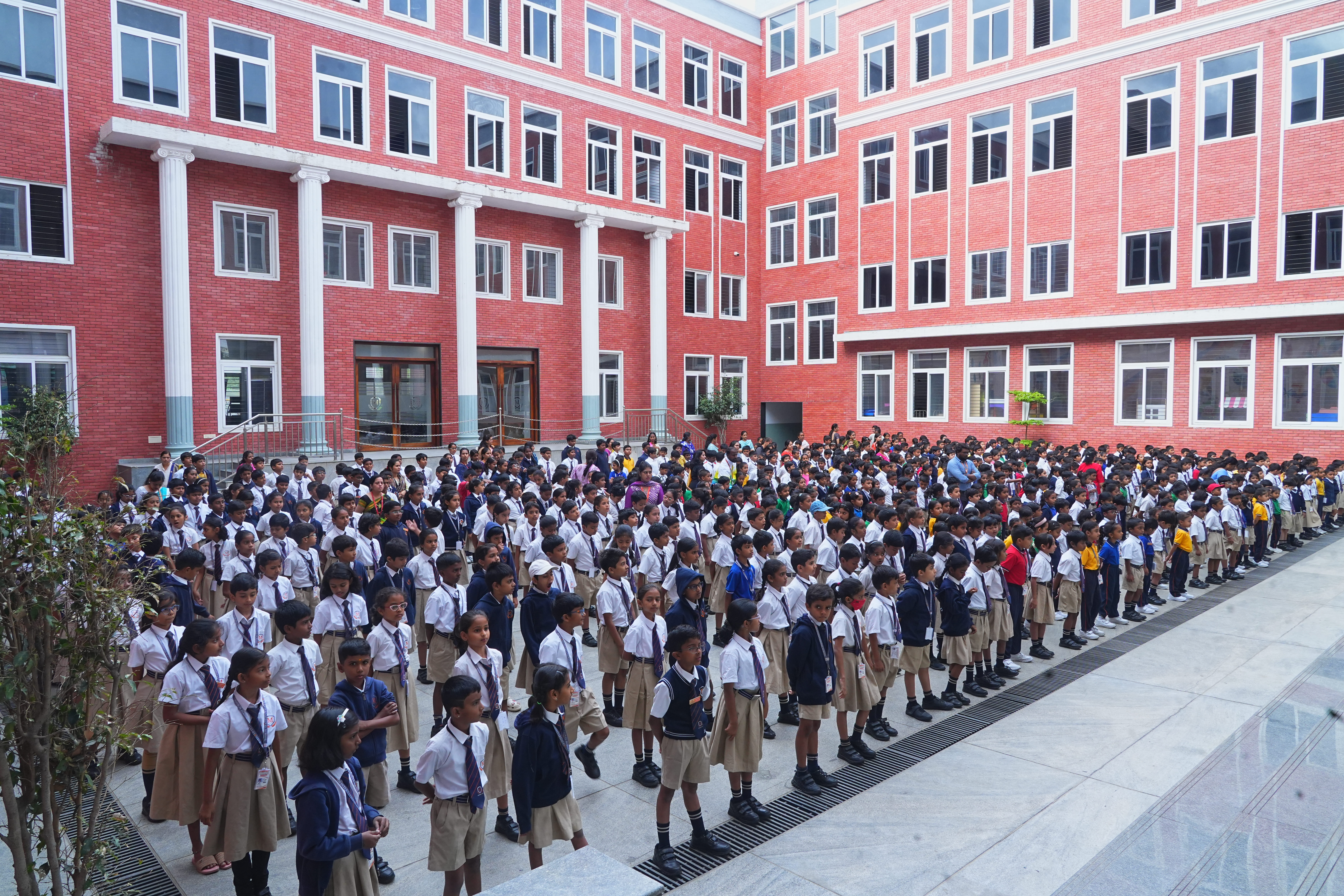
Why Land Is the Silent Differentiator in Bangalore Schools
Bangalore’s inner neighbourhoods — Jayanagar, JP Nagar, parts of Banashankari — were largely built out decades ago. Land is scarce and expensive, and most schools there operate on plots that were adequate for the class sizes of the 1990s, not the enrolment numbers of today.
This isn’t a criticism of those schools. It’s simply a physical constraint that no amount of good intention can undo.
Areas further along Mysore Road, including Kengeri and Kumbalgodu, developed later and still have access to genuinely large plots. This is precisely why some of the more spacious, purpose-built school campuses in south Bangalore have emerged in this corridor over the last several years.
For a parent, this translates into a real, tangible choice: a school built around compact, vertical infrastructure, or one built around open, horizontal space.
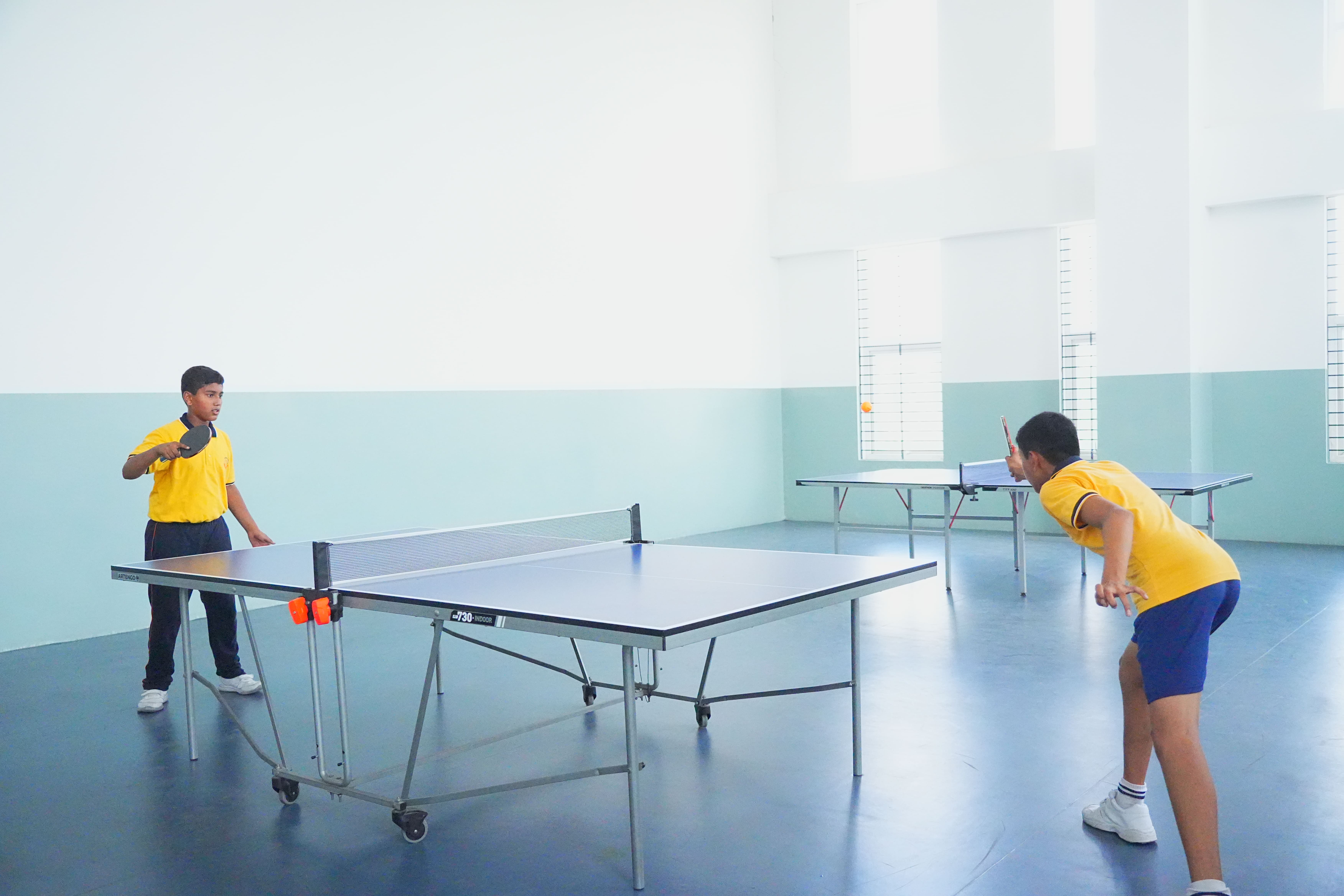
What a Large Campus Actually Gives Your Child
It’s easy to dismiss “big campus” as a real-estate flex rather than an educational advantage. It isn’t.
More movement, less restlessness. Children, especially under age ten, learn better after physical activity, not despite it. A campus with genuine playground space allows for real, unstructured movement between classes, not just a hurried five minutes in a corridor.
Actual sports infrastructure, not token facilities. A dedicated football field, running track, and multiple courts require acreage that a compact urban campus simply cannot provide, no matter how well-designed.
Cleaner air and quieter surroundings. Green, open campuses tend to sit further from the densest traffic corridors, meaning lower ambient noise and pollution exposure during the many hours your child spends there daily.
Room for age-appropriate zoning. A five-year-old and a fifteen-year-old have very different needs for space, noise level, and equipment. A larger campus can genuinely separate these zones; a compact one often can’t.
Space to grow without overcrowding. As enrolment increases over the years, a large campus can absorb that growth without every child’s individual space shrinking. On a tight urban plot, growth usually means more crowding, not more room.
The Kengeri–Kumbalgodu–Mysore Road Corridor, Explained
If you live in Kengeri, Uttarahalli, RR Nagar, or the newer layouts along Mysore Road, you’ve likely noticed this stretch has changed significantly over the past several years — better road infrastructure, growing residential development, and a wider range of school options than existed a decade ago.
Kumbalgodu specifically, sitting just off the Bangalore–Mysore highway, has become a notable pocket for larger, newer school campuses, partly because land was more available here than closer to the city core.
Marigold International School’s 10-acre campus in Kumbalgodu is a good example of what this corridor now offers: a genuinely large, green campus within a realistic commute for families across Kengeri, RR Nagar, and Uttarahalli, without the traffic burden of travelling into Jayanagar or JP Nagar for a comparable-quality option.
How to Actually Judge Campus Quality on a Visit
Don’t take “10 acres” or “sprawling green campus” at face value from any brochure. Verify it yourself.
Walk the boundary, or ask for a campus map with actual dimensions. Ask how much of the stated acreage is genuinely usable open space, versus buildings, parking, and unused land.
Ask to see the playground your specific child’s age group actually uses, not just the largest or most photogenic field on the property.
Visit during a break period if possible, and watch what children are actually doing. Are they moving, playing, engaged? Or standing in corridors because there’s simply nowhere else to go?
Ask about the sports curriculum specifically: how many periods per week, what sports are actually available with proper equipment and coaching, and whether facilities are shared across the entire school on a tight rotation.
Commute: The Other Half of the “Location” Equation
Campus size solves one part of the puzzle. Commute solves the other, and the two are deeply connected for families in this part of south Bangalore.
A school with an enormous campus that takes 50 minutes to reach in traffic isn’t actually solving your child’s daily quality of life — it’s just trading one problem for another.
This is where the Kengeri–Kumbalgodu–Mysore Road corridor offers a genuine advantage for local families: large campuses that are also realistically close, cutting both problems at once rather than forcing a trade-off between space and commute time.
Before finalising any school, physically drive the route at 7:30 am on a weekday. Not on a quiet Sunday afternoon during your campus tour. The real commute time is the number that matters.
Green Space and Child Wellbeing: What the Research Actually Says
This isn’t just a nice-to-have. A growing body of research on child development links regular access to green, open outdoor space with lower stress markers, better attention spans, and improved mood regulation in school-age children.
Children who spend meaningful time outdoors during the school day tend to show better focus once back in the classroom, compared to children confined to indoor spaces for most of the day.
For a city like Bangalore, where many children already live in dense apartment complexes with limited outdoor access at home, a genuinely green school campus can end up being one of the more significant sources of outdoor time in a child’s entire week.
This is worth weighing seriously, not as a bonus feature, but as a core factor in your decision — on par with academics and safety.
What “Facilities” Actually Requires in Terms of Land
Schools love listing facilities on their website: library, science labs, computer lab, auditorium, art room, music room, sports complex. It’s a long, impressive list.
What’s rarely mentioned is that each of these requires dedicated square footage that has to come from somewhere. On a compact urban plot, something usually gives — a “library” might be a converted classroom corner, a “science lab” might be shared across three grade levels on a tight schedule.
On a larger campus, these facilities can exist as genuinely dedicated, well-equipped spaces rather than multi-purpose rooms wearing several different hats depending on the hour.
When you visit any school, ask to see these spaces as they’re being used on a normal day, not staged for your tour. A working lab mid-experiment tells you far more than an empty, pristine one.
How Kengeri, RR Nagar, and Uttarahalli Have Changed the School Map
A decade ago, families in this part of south Bangalore often had to choose between a long commute into the city for a well-regarded school, or settling for a smaller, more limited local option.
That equation has genuinely shifted. Kengeri Satellite Town, the layouts around Uttarahalli, and the newer developments near RR Nagar have all seen substantial residential growth, and school infrastructure has, gradually, started to follow that demand.
The Mysore Road corridor toward Kumbalgodu in particular has benefitted from more available land, allowing newer schools here to build with room to spare — sports fields, auditoriums, and green buffers that would be nearly impossible to fit within, say, central Jayanagar today.
For a parent who moved to this part of the city partly for more space and a quieter environment at home, it makes sense to extend that same priority to where your child spends seven or eight hours a day.
A Parent’s Perspective: What Changed After Switching to a Bigger Campus
It’s a pattern that comes up repeatedly in parent conversations across Kengeri and RR Nagar: families who moved their child from a compact, city-centre school to a larger, more spacious campus often describe a noticeable shift, not in test scores immediately, but in mood.
Children come home less wound up. Sleep improves. There’s less resistance to going to school on a Monday morning.
None of this is easily measurable on a report card, but any parent who has lived through both experiences will tell you it’s real. Physical space genuinely changes how a child experiences their school day, day after day, for years.
What to Ask About Future Expansion Plans
A large campus today doesn’t guarantee it stays that way. Ask any school directly about their enrolment growth plans and whether new construction is expected to eat into current outdoor space over the coming years.
Some schools genuinely master-plan their land use in advance — reserving green space and sports grounds permanently, while building vertically for classrooms and labs as enrolment grows. Others simply build wherever there’s room, until the open space quietly disappears one construction phase at a time.
This is a reasonable, specific question to ask during your visit: “As the school grows, is this outdoor space protected, or will it eventually be built on?” A confident, direct answer is a good sign.
The Hidden Cost of a Cramped Campus Over Time
It’s worth naming a cost that rarely shows up in any brochure: what happens to a school’s culture, gradually, when a growing student body is squeezed into a campus that hasn’t grown with it.
Break times get staggered into smaller, tighter windows just to manage crowd flow. Sports periods rotate less frequently per class as more grades compete for the same limited ground. Assemblies move to shifts rather than the whole school gathering together.
None of this happens overnight, and none of it is usually visible on a single tour. It’s a slow accumulation that current parents at a crowded school will describe candidly if you ask them directly — one more reason talking to existing parents, not just admissions staff, matters so much in this specific evaluation.
Weighing Campus Against Every Other Priority
None of this means campus size should override everything else. A beautiful, sprawling campus with weak teaching or poor safety practices is still the wrong choice.
Think of campus and location as the foundation that everything else is built on. Good teaching happens more easily in an environment where children aren’t cramped, stressed, or exhausted from a brutal commute before the first bell even rings.
Use it as one major pillar in your decision, alongside curriculum approach, safety, fees, and teacher quality, all covered in more depth in our companion guide to choosing the best CBSE school in south Bangalore.
A Practical Checklist for Evaluating Campus and Location Together
- Real driving time from home during 7:30–8:30 am traffic, tested yourself
- Total campus acreage, and how much is genuinely usable outdoor space
- Dedicated play areas separated by age group
- Number and quality of sports facilities — fields, courts, tracks
- Greenery and shade, not just paved open space
- Room for future enrolment growth without overcrowding
- Proximity to main highways or busy roads, and how that affects noise and air quality
Score your shortlisted schools against this list honestly, alongside the fuller checklist in our companion guide on choosing the best CBSE school in south Bangalore.
Why This Matters More the Younger Your Child Is
The younger the child, the more their day is shaped by physical environment rather than academic content. A three or four-year-old learns as much through movement, sensory play, and outdoor exploration as through structured lessons.
For Nursery, LKG, and UKG specifically, prioritise campus and outdoor space even more heavily than you would for a Grade 8 admission decision, where academic infrastructure like labs and libraries starts to carry more weight.
This is one more reason it’s worth visiting a school like Marigold International School in person if you’re evaluating options anywhere near Kengeri, Kumbalgodu, RR Nagar, or Uttarahalli — walking a genuinely large, green campus tells you more in fifteen minutes than any brochure will in fifteen pages.
A Final, Honest Note
It’s worth saying plainly: not every family needs a 10-acre campus, and a smaller school with excellent teachers and a warm community can absolutely be the right fit for some children.
But if a large, green, well-resourced campus is realistically within reach of your commute, as it increasingly is for families across Kengeri, Kumbalgodu, RR Nagar, and Uttarahalli, it’s a genuine advantage worth taking seriously rather than dismissing as a nice-to-have.
Visit before you decide. Walk the grounds. Watch how children actually use the space on a normal day. That fifteen-minute experience will tell you more than any brochure, and more than this guide, ever could.
Frequently Asked Questions
Does a bigger campus always mean a better school? Not automatically — teaching quality, safety, and culture still matter enormously. But for physical development, outdoor access, and sports infrastructure, campus size is one of the most reliable indicators available.
Is the Kengeri–Mysore Road area considered “too far” from central Bangalore for a good school? Not anymore. Improved road connectivity and a growing number of quality campuses have made this corridor a genuinely competitive option, especially for families already living in Kengeri, RR Nagar, or Uttarahalli.
How much outdoor time should a young child realistically get during a school day? Educational and paediatric guidance generally recommends at least 45 minutes to an hour of active outdoor time daily for young children, which is difficult for schools with minimal outdoor space to consistently provide.
Should I prioritise campus size over academic reputation? Treat them as connected, not competing, factors. A school with strong teaching and a genuinely spacious campus offers the more complete environment; where you have to choose, weigh it against your child’s specific age and temperament.
How do I verify a school’s claimed campus size before enrolling? Ask for it in writing, request a campus map, and walk the grounds yourself during your visit rather than relying on marketing photography alone.
One last practical tip: visit your top campus choice twice — once on a scheduled tour, and once unannounced or during a normal pickup time if the school allows it. The second visit, without the polish of a planned tour, often tells you the most honest story about how the space is actually used day to day.
And a related point worth remembering: campus size is easiest to compare on paper, but the feeling of space is what actually matters day to day. Two schools claiming similar acreage can feel completely different depending on how thoughtfully that land has been zoned, landscaped, and maintained. Trust your own sense of the place as much as the number on the brochure.