


Somewhere between filling out the third admission form and photocopying the fourth birth certificate, most parents hit the same thought: why does getting a three-year-old into school feel this complicated?
It doesn’t have to be. Most of the stress comes from not knowing the sequence, not the actual difficulty of any single step.
This guide lays out the entire CBSE admission journey for south Bangalore families, from the first shortlist to the day your child walks in wearing a slightly-too-big uniform, term by term, so nothing catches you by surprise.
Step 1: Understand the Age Criteria Before You Do Anything Else
Age eligibility is the first filter, and it varies slightly by school and by year, so always confirm directly rather than relying purely on last year’s numbers.
As a general guideline for the 2026-27 academic year, most CBSE schools in Bangalore use a cut-off around 31st March or 1st June 2026, and expect:
- Pre-Nursery/Nursery: child should be around 3 years old
- LKG: around 4 years old
- UKG: around 5 years old
- Grade 1: around 6 years old
Each additional grade typically adds one year. Always verify the exact cut-off date with your shortlisted school directly, since Karnataka schools have historically used slightly different reference dates than schools in some other states.
If your child’s birthday falls close to the cut-off, ask the school specifically whether any flexibility exists — some do offer limited discretion, particularly for children just a few weeks under the line.
Step 2: Start Your Timeline Early — Earlier Than Feels Necessary
Most CBSE schools in south Bangalore open admissions for the following academic year between September and January, with popular schools filling seats well before the final deadline.
A realistic timeline looks like this:
- 6 to 8 months before the academic year starts: Begin shortlisting schools and researching options.
- 4 to 6 months before: Visit shortlisted campuses, ask your detailed questions, and narrow down to 2-3 final choices.
- 3 to 5 months before: Submit registration forms as soon as admissions officially open at your top choices.
- 2 to 4 months before: Attend the interaction session or assessment, if applicable, and complete document verification.
- 1 to 2 months before: Confirm the seat, pay fees, and complete uniform and transport arrangements.
Starting late doesn’t mean you won’t get admission anywhere — it usually just means settling for a school lower on your list simply because seats ran out elsewhere.
Step 3: Shortlist Realistically, Not Aspirationally
It’s tempting to shortlist five or six “dream” schools regardless of commute or fit. Resist that instinct.
Apply the same filters covered in our companion guide on choosing the best CBSE school in south Bangalore — realistic commute, campus quality, board continuity, and budget — before you shortlist, not after you’ve already fallen in love with a prospectus.
A tighter, more realistic shortlist of three to four schools makes the rest of this process significantly less exhausting, and increases your odds of actually getting a seat you’re happy with.
Step 4: Gather Documents Early — This Step Alone Causes Half the Stress
Almost every CBSE school in Bangalore asks for a broadly similar document set. Preparing these in advance, before admissions even open, removes a huge chunk of last-minute panic.
Typical documents required:
- Birth certificate (original and photocopies)
- Address proof (Aadhaar, passport, utility bill, or rental agreement)
- Passport-size photographs of the child and both parents
- Aadhaar card copies for the child and parents
- Transfer certificate, if switching from a previous school
- Previous academic records or report cards, for older grades
- Category or reservation certificates, if applicable
- Immunisation or medical records, in some cases
Keep both physical and scanned digital copies of everything. Many schools now run at least part of the process online, and having documents ready in both formats saves real time.
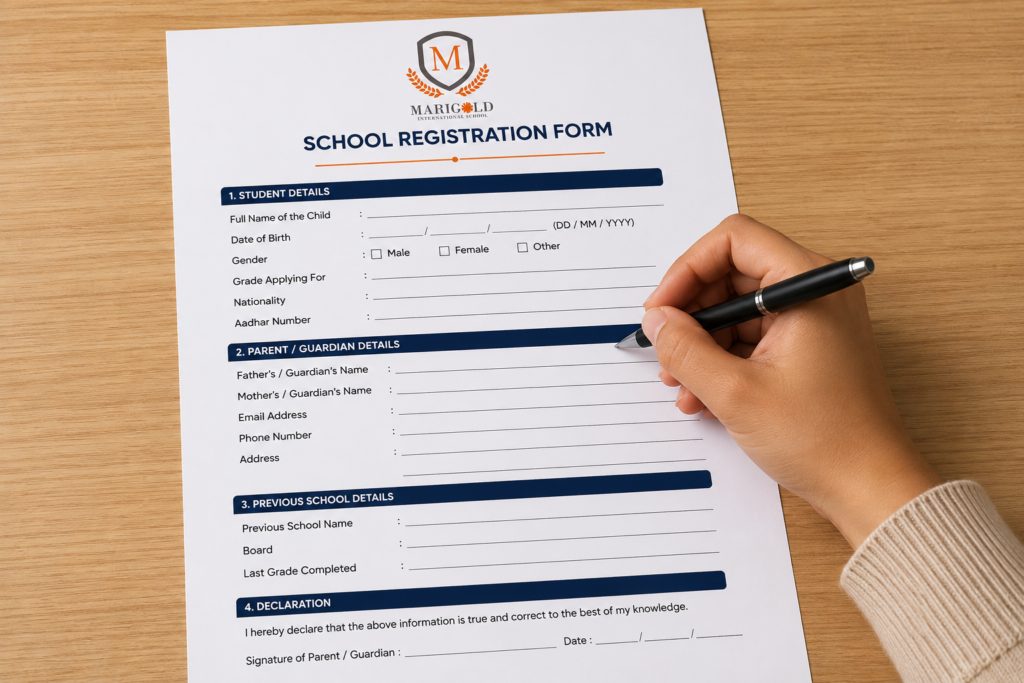
Step 5: The Registration Form and Fee
Registration typically involves filling out a form (often available on the school’s website) and paying a nominal registration fee — usually a few hundred to around a thousand rupees, non-refundable in most cases.
This fee only secures your child’s place in the admission process, not the seat itself. Don’t confuse the two — plenty of anxious parents assume registration alone guarantees admission, and it doesn’t.
Step 6: The Interaction Session or Assessment
For Nursery through roughly Grade 2, most CBSE schools conduct a short, informal interaction rather than a formal test — recognising shapes, colours, simple conversation, basic motor skills.
This is not something to over-prepare for with flashcards and drilling. Admissions teams are specifically trained to notice over-coached children, and a relaxed, curious child usually leaves a better impression than a rehearsed one.
For Grade 3 and above, expect a basic academic assessment covering reading, writing, and maths appropriate to the grade level, sometimes alongside a parent interaction as well.
Practical tip: keep your child well-rested and fed before any interaction session. A cranky, overtired child performs worse than a well-prepared one, regardless of actual ability.
Step 7: Document Verification and Seat Confirmation
Once selected, you’ll typically receive a confirmation call or email, followed by a request to submit original documents for verification.
At this stage, the school will usually ask you to pay the admission fee within a specific window — often quite short, sometimes just a week or two — to confirm the seat. Missing this window can mean losing the seat to the next child on the waitlist.
Keep a calendar reminder for this deadline the moment you receive it. This is the single most common point where families lose a seat they’d otherwise secured, purely due to a missed payment window.
Step 8: Transport, Uniform, and Orientation
Once the seat is confirmed, most schools open transport registration, uniform ordering, and share an orientation date for parents, sometimes with a separate settling-in session for the child.
Ask specifically about transport routes near your home in Kengeri, Kumbalgodu, RR Nagar, or Uttarahalli at this stage — routes and stop locations sometimes need a few weeks’ notice to be finalised, especially for newer residential layouts.
Special Situations Worth Planning For
Sibling admissions. Many schools offer some form of priority consideration for younger siblings of currently enrolled students, though this is rarely automatic. Ask specifically about the sibling policy and whether it affects the registration timeline or fee.
Mid-year relocation to south Bangalore. Families moving into Kengeri, RR Nagar, or the Mysore Road corridor from another city often need to navigate admission outside the standard cycle. Start by contacting admissions offices directly with your child’s current transfer certificate and report cards, since mid-year seats depend heavily on real-time availability rather than a published timeline.
Transferring from a different board. Moving from ICSE or State Board into a CBSE school, or vice versa, sometimes involves an additional academic assessment to gauge syllabus alignment, particularly from Grade 3 onward. Ask the receiving school directly what bridging support, if any, they offer during the first term.
Twins or multiple children applying in the same cycle. If you’re applying for more than one child at once, ask whether the school processes these applications together or independently, and whether any combined fee consideration exists.
Understanding the Transfer Certificate Process
If your child is moving from another school, the Transfer Certificate, or TC, is one of the most commonly delayed documents in the entire process, and it’s worth starting this conversation with your current school early.
Some schools only issue the TC after the academic year formally closes, even if your child is leaving mid-year, which can create a temporary documentation gap. Ask your new school directly how they handle provisional admission in this scenario — most experienced admissions offices have a standard workaround, such as accepting a provisional or bonafide certificate in the interim.
Keep both the TC and previous report cards in a single folder, physical and scanned, from the very start of your search. It saves a genuinely stressful scramble later in the process.
Preparing Your Child Emotionally, Not Just Administratively
Amid all the forms and deadlines, it’s easy to forget that this process is also happening, quietly, from your child’s perspective.
For a first-time Nursery admission, keep the actual interaction session low-pressure in how you talk about it at home. Avoid words like “test” or “exam” with a three-year-old — a simple “we’re going to meet some new teachers and see a fun new place” works far better.
For older children switching schools, involve them in the campus visit if possible, and let them ask their own questions. A child who feels some ownership over the choice typically settles in faster than one who experiences the move as something that simply happened to them.
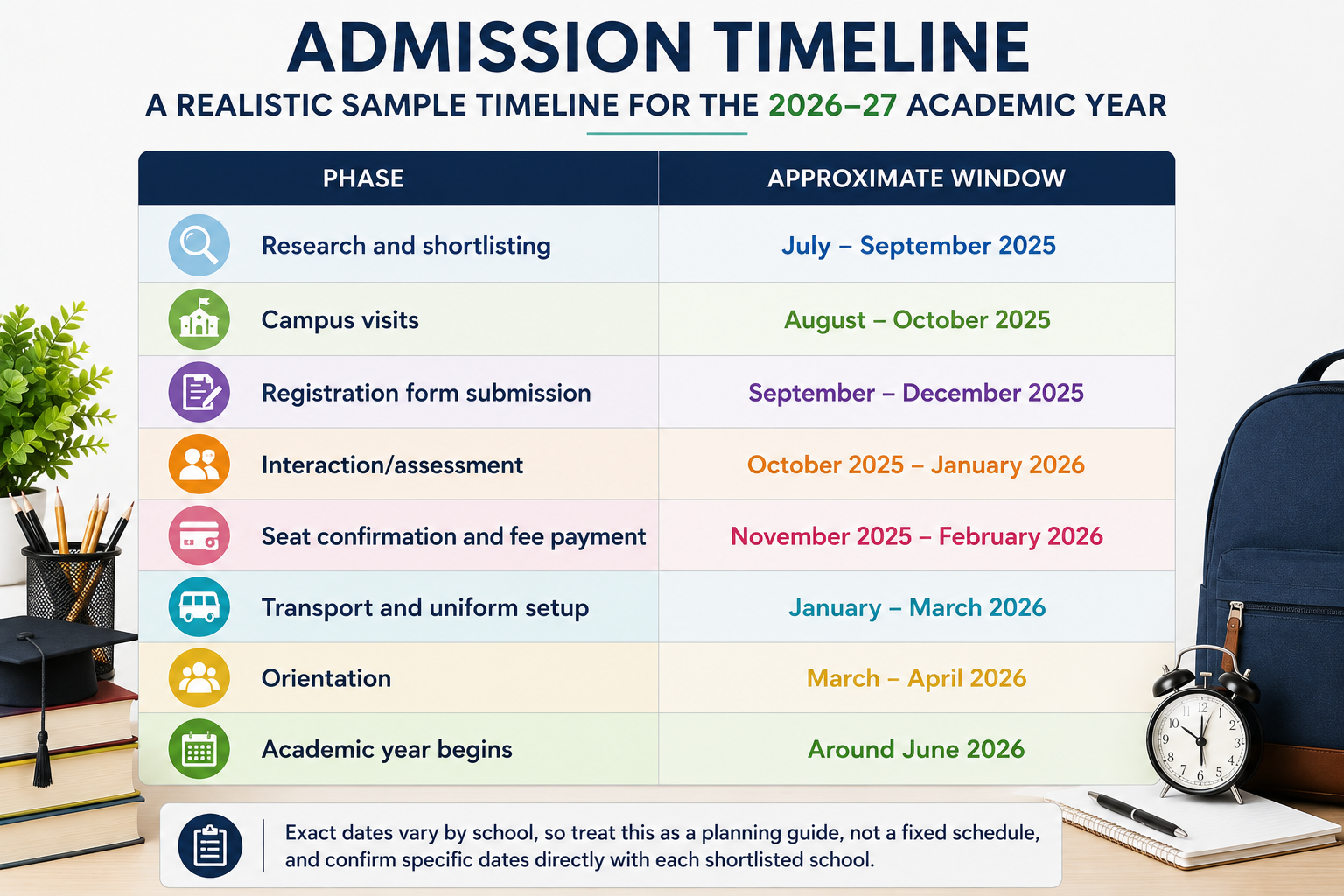
A Realistic Sample Timeline for the 2026-27 Academic Year
| Phase | Approximate Window |
|---|---|
| Research and shortlisting | July – September 2025 |
| Campus visits | August – October 2025 |
| Registration form submission | September – December 2025 |
| Interaction/assessment | October 2025 – January 2026 |
| Seat confirmation and fee payment | November 2025 – February 2026 |
| Transport and uniform setup | January – March 2026 |
| Orientation | March – April 2026 |
| Academic year begins | Around June 2026 |
Keeping a Simple Admission Tracker
With two or three schools in play simultaneously, details blur together faster than expected. A simple tracker, even a basic notebook or spreadsheet, prevents avoidable mix-ups.
Track, for each school: registration date and reference number, documents submitted and pending, interaction or assessment date, admission fee deadline, and the name and direct contact of your admissions point of contact.
This becomes especially useful if you’re coordinating between two working parents, since either of you can pick up a follow-up call without having to reconstruct the entire history from memory in that moment.
Budgeting Time, Not Just Money, for This Process
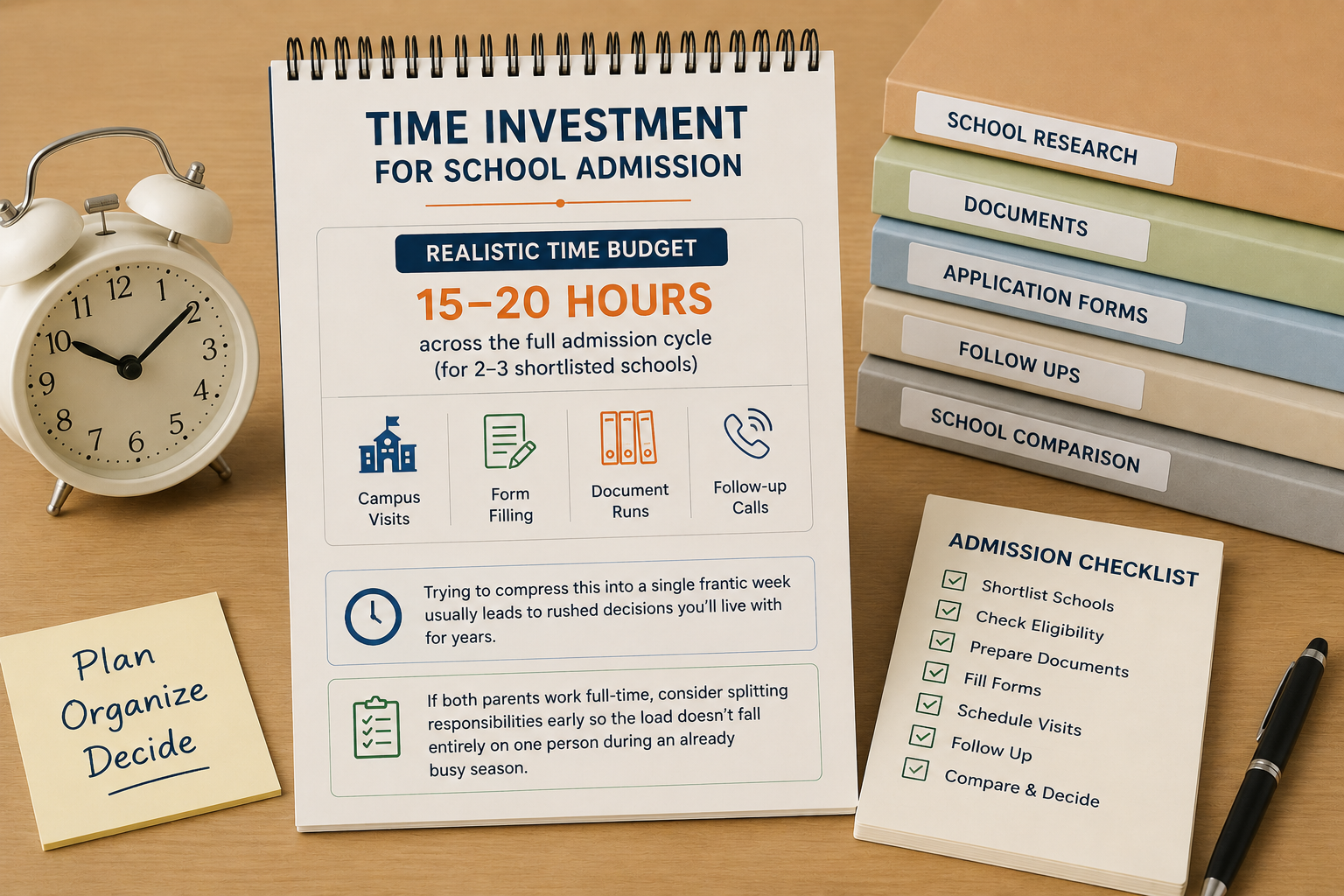
Parents plan carefully for admission fees but rarely block out the actual hours this process consumes — campus visits, form-filling, document runs, follow-up calls.
Realistically, budget at least fifteen to twenty hours total across the full admission cycle for a thorough, unrushed process across two to three shortlisted schools. Trying to compress this into a single frantic week usually leads to rushed decisions you’ll live with for years.
If both parents work full-time, consider splitting responsibilities early — one handles document preparation while the other coordinates campus visits and admissions communication — so the load doesn’t fall entirely on one person during an already busy season.
Common Mistakes Parents Make During This Process
Applying to only one school. Even a strong candidate can miss out due to limited seats. Apply to at least two to three schools within your realistic shortlist.
Missing the fee payment window after selection. This is the most common, most avoidable way families lose a secured seat.
Over-coaching a young child for the interaction session. It rarely helps and sometimes backfires, since admissions teams are trained to spot it.
Not confirming the exact age cut-off date with the specific school. State-level and school-level variations exist, and assuming last year’s date is unchanged can cause an unpleasant surprise.
Ignoring the realistic commute during the excitement of admission season. The admission process moves fast, and it’s easy to lose sight of practical daily logistics in the moment. Revisit your shortlist criteria before signing anything.
What Makes This Process Smoother
Schools that run a clear, well-communicated admission process — published timelines, responsive admissions staff, transparent fee structures — make an already stressful process meaningfully easier.
When you’re evaluating schools during your shortlisting phase, pay attention to how organised and transparent their admissions communication is. It’s often a fair preview of how the school communicates once your child is actually enrolled.
Marigold International School, for families based near Kengeri, Kumbalgodu, RR Nagar, or Uttarahalli, runs admissions from Pre-Nursery through Grade 11 with a straightforward registration process — a reasonable option to include on your shortlist and reach out to directly for current-year dates and documentation requirements.
A Final, Honest Note
Admission season is genuinely stressful, and no guide fully removes that. What it can do is replace vague anxiety with a clear checklist and timeline, so the stress you do feel is about your child’s future, not about scrambling for a missing document at the last minute.
Start early, keep your documents organised from day one, and don’t let the process rush you into a school that doesn’t actually fit your family’s needs. A slightly slower, more deliberate search almost always beats a rushed one.
Frequently Asked Questions
What is the ideal age to start Nursery for the 2026-27 academic year? Most schools expect the child to be around 3 years old as of the school’s specific cut-off date, typically falling between March and June 2026. Always verify the exact date with each individual school.
Is there an entrance exam for CBSE admissions in south Bangalore? For Nursery through roughly Grade 2, it’s usually a short, informal interaction rather than a formal exam. From Grade 3 onward, expect a basic academic assessment appropriate to the grade level.
How many schools should I apply to? Two to three schools within your realistic shortlist is a sensible balance — enough to hedge against limited seats, without making the process unmanageable.
What happens if I miss the fee payment deadline after seat confirmation? In most cases, the seat is released to the next child on the waitlist, so treat this deadline as non-negotiable and set a clear reminder the moment you receive it.
Can I apply for mid-year admission if I move to south Bangalore outside the usual admission window? Many schools do accommodate mid-year transfers, subject to seat availability in the relevant grade. Contact the admissions office directly, since this process runs separately from the main annual admission cycle.
One last practical tip: save every admission-related email and receipt in a single dedicated folder, digital or physical, from the very first registration form onward. Admission disputes and mix-ups are rare, but when they happen, having a clean paper trail resolves them in minutes instead of days.
And a final reminder: the admission process, stressful as it feels in the moment, is a small fraction of your child’s entire school journey. Once the seat is secured and the first term settles into a rhythm, most of this anxiety fades quickly. Give yourself permission to feel relieved once you’ve done the diligence — you don’t need to keep second-guessing a decision made carefully and on time.
One more scenario worth preparing for: waitlists. It’s common, especially at popular schools, to be placed on a waitlist rather than receiving an immediate yes or no. Ask directly how the waitlist is ordered, roughly how many families are typically ahead of you in a given grade, and by when you’ll get a final answer. Use this window productively — keep your backup school’s process moving in parallel rather than pausing everything while you wait, since a confirmed backup seat is far better than an indefinite hope for your first choice.