


A couple of months into a new school year, or a new school altogether, most parents in south Bangalore are asking themselves some version of the same question: is my child actually settled here, or just going through the motions?
It’s not always obvious. Children, especially younger ones, don’t always have the words to say “I’m still finding this hard,” and older children sometimes deliberately downplay struggles to avoid worrying you. This guide walks through the real signs worth watching for, and what to do if the picture isn’t as settled as you’d hoped.

Why the First Term Matters So Much
Whether your child just started Nursery, moved up a stage, or transferred from another school entirely, the first term genuinely shapes how they experience the rest of the year. A child who settles well tends to build momentum — confidence, friendships, a sense of belonging — that carries them through the harder patches later in the year far more easily.
A child who struggles quietly through an unsettled first term, without it being noticed and addressed, can end up carrying that discomfort much longer than necessary, sometimes shaping how they feel about school more broadly.
This is exactly why it’s worth paying close, deliberate attention during these early months, rather than assuming things will naturally sort themselves out.
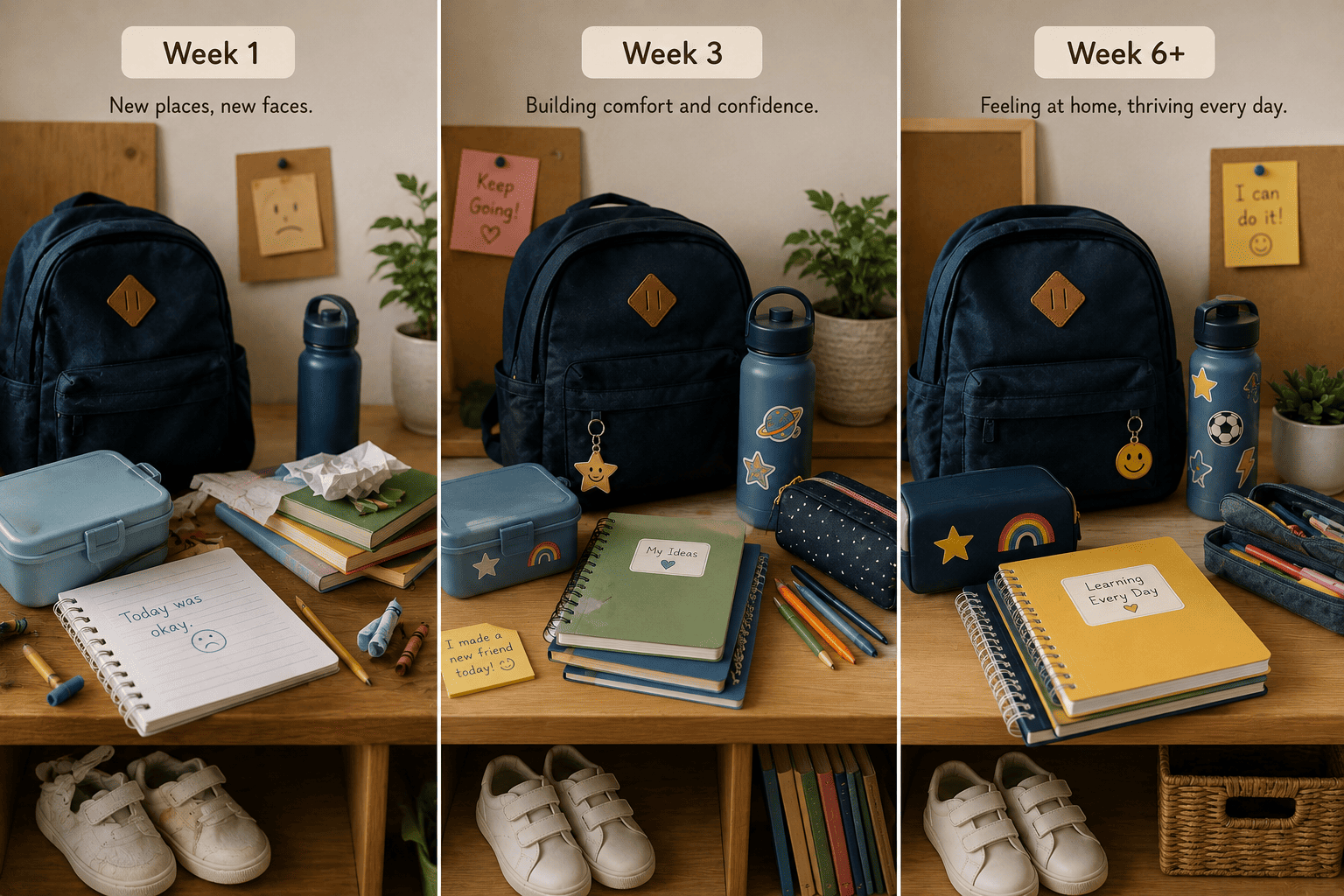
Positive Signs Worth Noticing
Specific stories, not just generic answers. A child who mentions particular classmates by name, describes a specific moment from their day, or brings up an ongoing thread from earlier in the week — “remember I told you about the class pet” — is engaged enough to be forming a real, detailed picture of their days, not just passing through them.
Growing independence around school routines. Packing their own bag, remembering their own water bottle, managing their own timetable without constant reminders — small signs of ownership that suggest genuine comfort with the daily rhythm.
A consistent, not necessarily constant, willingness to go to school. Some reluctance on some mornings is completely normal for every child, settled or not. What matters is the overall pattern — is most mornings fine, with occasional low-energy days, or is nearly every morning a genuine struggle?
Bringing school language and habits home. A child repeating a phrase their teacher uses, humming a song learned in class, or applying a classroom routine at home (like a specific way of tidying up) shows the school environment is genuinely shaping their world, not staying separate from it.
Physical ease around drop-off and pickup. A child who separates from you at drop-off with reasonable comfort, even if there’s a brief moment of clinginess, and who greets pickup with visible relaxation rather than tension, is showing you something real about their day.
Signs Worth Paying Closer Attention To
Persistent vagueness about their day, especially if this is new. “Fine,” “nothing,” and “I don’t remember” as the only answers, especially if this is a shift from a more talkative child, can sometimes signal disengagement rather than simple shyness.
Physical complaints that cluster around school days. Stomach aches, headaches, or general unwellness that reliably show up on school mornings and resolve on weekends are a well-documented pattern worth taking seriously, not dismissing as coincidence.
Regression in previously mastered skills. A child who was toilet-independent regressing, or a previously confident reader suddenly resisting reading aloud, can sometimes reflect underlying stress finding an outlet in an unrelated area.
Reluctance to discuss specific parts of the day, like lunch or break time. If academic subjects come up easily but anything related to unstructured social time gets deflected, it’s worth gently exploring further, since this often points to social discomfort specifically.
Sudden changes in sleep or appetite. Difficulty falling asleep on school nights, or a noticeable change in how much they’re eating, can be a quieter signal that something about the daily routine feels genuinely stressful.
None of these signs alone is necessarily cause for alarm — every child has occasional off days and phases. What matters is the pattern over several weeks, not any single instance.

How to Have the Conversation Without Making It Feel Like an Interrogation
Direct questions like “are you okay at school?” often get a reflexive “yes” regardless of the real answer, simply because it’s the easiest, quickest response for a child who isn’t sure how to unpack something more complicated.
Side-door questions tend to work better. “What was the funniest thing that happened today?” or “who did you sit with at lunch?” or “what’s something you wish was different about school?” open up more specific, honest answers than a broad check-in question.
For younger children, play can reveal more than direct conversation. Watching how they play “school” with toys or during pretend play at home sometimes surfaces feelings and observations they haven’t consciously articulated yet.
A Real Scenario Worth Recognising
Consider a common pattern: a bright, previously enthusiastic child starts complaining of stomach aches every school morning, but seems completely fine by mid-morning on weekends, and pediatric checks find nothing physically wrong.
This is a genuinely well-documented pattern, often linked to underlying anxiety the child hasn’t consciously connected to school itself, or doesn’t yet have the words to express directly. It doesn’t necessarily mean something is seriously wrong at school — it might be something as specific as a single difficult peer interaction, a subject they’re quietly struggling with, or simply the general effort of adjusting to a demanding new routine.
The right response isn’t to dismiss the physical complaint, nor to immediately assume the worst about the school. It’s to gently investigate, in conversation with both your child and their teacher, what specifically might be underlying the pattern, and address that directly rather than only treating the physical symptom.
Helping an Only Child or a Naturally Reserved Child Settle In
Some children, by temperament or family context, find the social side of a new school more effortful than others. This is worth acknowledging honestly rather than assuming every child adjusts socially at the same pace.
For a naturally reserved child, small, structured social opportunities — a playdate with one specific classmate outside school hours, rather than expecting them to navigate a large, unstructured group — often build confidence more effectively than simply hoping they’ll find their footing in the classroom alone.
Ask the teacher if there’s a particular classmate they’ve noticed your child gravitating toward, even briefly, and consider using that as a starting point for a low-pressure outside-school connection. A single genuine friendship often does more for a child’s overall sense of belonging than a wider circle of surface-level acquaintances.
What Role Siblings and Family Routine Play
If your child has an older or younger sibling at the same school, or a cousin or close family friend in the same grade, this can meaningfully ease the settling-in process, giving them a familiar anchor point in an otherwise new environment.
Conversely, if a sibling is struggling with their own adjustment at the same time, it’s worth being mindful that household stress can compound for both children, and giving each child individual, undivided attention during this period — even just ten minutes of dedicated conversation each evening — can help both settle more smoothly than if their experiences get lumped together.

What to Do If You Notice Genuine Struggle
If, after a few weeks of paying closer attention, a pattern of real difficulty emerges, the first and most useful step is a direct, specific conversation with your child’s teacher, ideally outside a routine parent-teacher meeting if the concern feels time-sensitive.
Share what you’ve observed at home specifically — dates, patterns, specific comments your child has made — rather than a general “I think something’s wrong.” This gives the teacher something concrete to connect with what they’re seeing, or not seeing, in the classroom.
Ask directly whether the teacher has noticed anything similar, different, or entirely unrelated in the classroom setting, since a child’s struggle sometimes shows up quite differently at school than it does at home.
Why Some Children Take Longer Than Others, and Why That’s Okay
It’s worth normalising, both for yourself and for your child, that settling-in timelines vary enormously and aren’t a reflection of anything being wrong.
A naturally more cautious or sensitive child may simply need more time to feel secure in a new environment than a naturally more outgoing one, and this isn’t a character flaw or a sign of a poor fit — it’s simply a difference in temperament that deserves patience rather than pressure.
Comparing your child’s settling-in pace to a sibling’s, a cousin’s, or a neighbour’s child rarely helps and can sometimes add unnecessary pressure. Focus on whether your own child is showing gradual, forward movement over time, even if that movement is slower than you’d hoped.
How a School’s Structure Affects Settling-In Time
Some aspects of a school’s design genuinely make settling in easier, and it’s worth understanding what to look for, whether you’re troubleshooting a current struggle or evaluating options for the future.
Smaller, more stable class groupings, where a child sees the same familiar faces consistently across the day, tend to support faster social comfort than larger, more fragmented groupings where children constantly shift between different peer groups for different subjects.
A structured, predictable daily routine, especially in the early years, gives children a clear sense of what to expect, reducing the low-level anxiety that comes from uncertainty about what happens next.
Teachers who are specifically attentive to social dynamics, not just academic content, in the early weeks of a term tend to catch and address settling-in struggles earlier, before they become more entrenched.
What This Looks Like in Practice
A school that takes settling-in seriously typically has some structured way of checking in during the first several weeks of a new term or a new child’s enrolment, rather than assuming everything is fine simply because no formal complaint has been raised.
At Marigold International School, the stage-wise curriculum structure — Nursery through UKG as one developmental stage, moving into the primary years — is designed partly around this idea, keeping children in more stable, familiar groupings during the years when social and emotional adjustment matters most, alongside academic learning.
For families evaluating this specifically, it’s worth asking any school directly how they support new children, or children moving between stages, during the first few weeks — a specific, structured answer here is a good sign.
Frequently Asked Questions
How long is a normal settling-in period for a new school? This varies significantly by child and age, but as a general guide, most children show clear signs of settling within four to six weeks, though some naturally take longer, particularly for a first-time Nursery admission or a mid-year transfer.
Should I be worried if my child still seems unsettled after two months? It’s worth a direct conversation with the teacher at this point, if you haven’t already had one, to compare notes and jointly figure out next steps, rather than assuming it will simply resolve on its own indefinitely.
Is it normal for settling-in to happen unevenly, with good weeks and harder ones? Yes, this is very common and doesn’t necessarily indicate a problem, as long as the overall pattern trends toward improvement over several weeks rather than staying flat or worsening.
Can moving from one CBSE school to another cause a longer settling-in period than starting fresh? Sometimes, particularly if teaching style, classroom culture, or friend group expectations differ significantly between the two schools. Give your child grace to adjust to these differences, even if the curriculum itself is technically the same.
What if my child seems settled academically but still hasn’t made close friends? Raise this specifically with the teacher, since social comfort and academic comfort don’t always develop at the same pace, and a teacher can often provide gentle, structured support for building friendships without making it feel forced or obvious to the child.
When to Trust Your Instinct Over a “Wait and See” Approach
Teachers and other parents will sometimes, with good intentions, encourage you to simply give it more time if you raise an early concern. This is often good advice — many settling-in struggles genuinely do resolve with a bit more patience.
But you know your child better than anyone else observing them for a few hours a week. If your instinct persistently tells you something feels off, beyond what seems like normal adjustment, it’s reasonable to keep raising it, gently and specifically, rather than fully deferring to a “give it more time” response indefinitely.
There’s a meaningful difference between healthy patience and prolonged silence about a genuine concern. Trust your own observations enough to keep the conversation open, even while remaining genuinely open to the possibility that more time is, in fact, all that’s needed.
A Final, Honest Note
Settling into a new school is rarely a straight line. Most children move through it in fits and starts — a great week followed by a harder one, sudden progress followed by an unexpected setback.
Trust the overall direction more than any single day, stay genuinely curious rather than anxious in how you check in, and don’t hesitate to loop in the teacher early rather than waiting for a struggle to become entrenched.
One last practical tip: keep a loose, informal log — even just a few notes in your phone — of specific things your child mentions about school each week. Patterns that aren’t obvious day to day often become clear once you look back over a few weeks of small observations together.
Why This Matters Beyond Just This Term
How a child’s first settling-in experience unfolds, whether it’s their first-ever school transition or a later one, quietly shapes how they approach future transitions too — a new grade, a new school, eventually a new city or job much further down the line.
A child who learns early that unsettled feelings can be voiced, taken seriously, and worked through collaboratively with the adults around them carries that confidence forward. A child who learns to simply push through discomfort silently, without it being noticed or addressed, sometimes carries that pattern forward too, in less helpful ways.
This is, in a small but real sense, one of the quieter long-term gifts of getting this first stretch right — not just a smoother term, but a healthier lifelong relationship with change and adjustment more broadly.
Is it normal for a settled child to occasionally regress, even after a genuinely good start? Yes, this is common, particularly around transitions like a new term, a change in class teacher, or after a longer school break. A brief regression after a period of genuine settledness usually resolves faster than the initial adjustment did, since your child has already built the underlying skills and comfort once before. Give it the same patient, curious attention you gave the first time around, without assuming it signals a bigger underlying problem.