


Somewhere around September and October, most CBSE schools in south Bangalore run their first significant periodic or half-yearly assessments of the year. For a child new to this rhythm — first-time exam-takers, or children who’ve just moved up into a grade where assessments carry more weight — this can be a genuinely nerve-wracking first encounter with something that will be part of school life for years to come.
How this first real exam experience goes matters more than any single test score. It shapes how a child relates to assessment, pressure, and their own capability going forward. This guide is about helping your child through it well, not just getting through it.
Why the First Real Exam Feels So Different
Up to this point, most of your child’s schoolwork has likely felt fairly low-stakes — classwork, small quizzes, regular homework. A half-yearly or periodic assessment feels different, often for the first time, because it’s explicitly framed as something that “counts,” covering weeks or months of material at once, with a formal, structured setting that can feel unfamiliar and a little intimidating.
This shift is developmentally normal and, handled well, is actually a valuable step in a child’s growing capacity to manage pressure and prepare systematically for something larger than a single day’s work. The goal isn’t to eliminate all nervousness — some is completely normal and even useful — but to help your child develop healthy tools for managing it.
Why the First Real Exam Feels So Different
Up to this point, most of your child’s schoolwork has likely felt fairly low-stakes — classwork, small quizzes, regular homework. A half-yearly or periodic assessment feels different, often for the first time, because it’s explicitly framed as something that “counts,” covering weeks or months of material at once, with a formal, structured setting that can feel unfamiliar and a little intimidating.
This shift is developmentally normal and, handled well, is actually a valuable step in a child’s growing capacity to manage pressure and prepare systematically for something larger than a single day’s work. The goal isn’t to eliminate all nervousness — some is completely normal and even useful — but to help your child develop healthy tools for managing it.
Recognising the Difference Between Healthy Nervousness and Genuine Anxiety
A small amount of pre-exam nervousness is not just normal, it’s actually functional — it sharpens focus and signals to a child that something matters. The goal isn’t a completely calm, indifferent child walking into an exam room.
Genuine exam anxiety looks different and more intense: physical symptoms like stomach aches or trouble sleeping in the days leading up to the assessment, catastrophic thinking (“I’m going to fail everything”), avoidance of studying altogether because the anticipation feels overwhelming, or a level of distress that seems disproportionate to what’s actually at stake for a periodic school assessment.
If you notice the second pattern rather than the first, it’s worth taking a more active, supportive approach, covered in more detail below, rather than assuming your child will simply toughen up with exposure alone.
Helping Your Child Prepare Practically, Not Just Emotionally
Good preparation itself is one of the most effective anxiety-reduction tools available, since much of exam-related stress stems from feeling unprepared or uncertain about what to expect.
Start well before the exam, with a realistic study plan. Cramming in the final day or two tends to increase anxiety rather than reduce it, since it confirms a child’s fear that there wasn’t enough time. A spread-out plan, even a simple one covering two to three weeks, builds genuine confidence alongside genuine knowledge.
Break subjects into manageable chunks. A vague goal like “study science” feels overwhelming. A specific goal like “review chapters 3 and 4 today” feels achievable, and achievable goals build the kind of steady confidence that reduces anxiety far more effectively than a large, undefined task.
Practice with past papers or sample questions where available, since familiarity with the actual format of an assessment reduces the fear of the unknown, which is often a bigger driver of anxiety than the content itself.
Build in genuine breaks, not just study time. A study schedule that leaves no room for rest or normal downtime tends to increase stress rather than improve outcomes, and can also send an implicit message that anything other than studying is somehow wasteful during this period, which isn’t a healthy long-term association to build.
Helping Your Child Manage the Emotional Side
Practical preparation addresses one half of the picture. The emotional side deserves just as much deliberate attention.
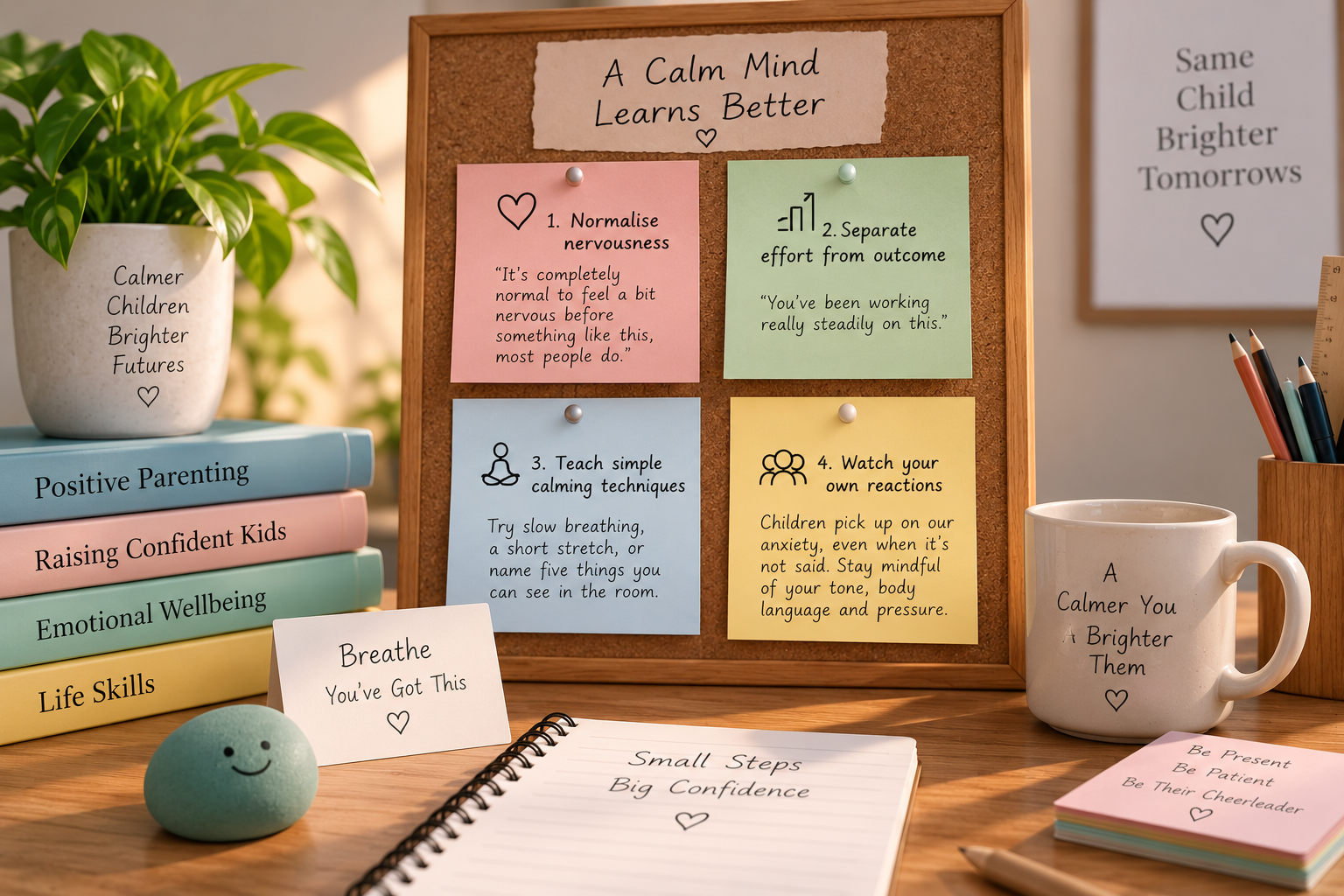
Normalise nervousness without dismissing it. “It’s completely normal to feel a bit nervous before something like this, most people do” validates the feeling without amplifying it into something alarming. Avoid both extremes — neither “don’t worry, it’s nothing” (which can feel dismissive) nor excessive reassurance that inadvertently signals this really is a very big deal.
Separate effort from outcome in how you talk about the exam. Praising and focusing on genuine, consistent effort — “you’ve been working really steadily on this” — builds a healthier relationship with achievement than focusing primarily on the anticipated result.
Teach simple, concrete calming techniques appropriate to your child’s age. Slow breathing, a brief physical stretch, or a simple grounding exercise — naming five things they can see in the room — can genuinely help a child manage acute nervousness in the moments right before or even during an exam.
Watch your own reactions closely. Children are remarkably perceptive about a parent’s underlying anxiety around their academic performance, even when it’s never stated directly. If exam season makes you personally anxious, it’s worth being mindful of how that anxiety might be transmitting to your child through tone, body language, or subtle pressure you’re not fully aware you’re applying.
What Not to Do, Even With Good Intentions
Avoid comparing your child’s preparation or performance to a sibling’s or classmate’s. This rarely motivates in the way parents hope, and more often increases anxiety and resentment rather than effort.
Avoid tying rewards or punishments too tightly to specific marks. This can create a transactional relationship with learning that undermines genuine curiosity and turns the exam into something to fear rather than simply a normal, manageable part of school life.
Avoid excessive last-minute cramming sessions the night before, even if your child insists on it out of anxiety. A calm evening, a reasonable bedtime, and a good breakfast the next morning genuinely matter more for performance than an extra hour of frantic, exhausted review.
Avoid discussing the exam extensively in the hours immediately before it. Continuing to quiz or review right up until the exam often increases anxiety rather than reinforcing knowledge at that late stage. A calm, ordinary morning routine tends to serve a child better than a final cramming push.
A Real Scenario Worth Recognising
Consider a common situation: a generally capable Grade 4 student, facing her first half-yearly exam covering multiple subjects at once, starts refusing to study altogether in the final week, insisting there’s “no point” and that she’s “going to fail anyway.”
This kind of avoidance often looks like laziness or lack of motivation on the surface, but it’s frequently the opposite — a child so overwhelmed by anticipated failure that avoiding the task entirely feels emotionally safer than trying and potentially confirming the fear. This is a well-documented pattern in anxious high-achievers especially, where the fear of not meeting one’s own standard becomes paralysing rather than motivating.
The right response isn’t to push harder on the original study plan, which usually deepens the avoidance. It’s to scale the task down dramatically — “let’s just look at one page together” — rebuilding a sense of manageable momentum before gradually expanding back toward the fuller plan, alongside calm, repeated reassurance that your support isn’t contingent on the eventual result.

Age-Appropriate Approaches to Exam Preparation
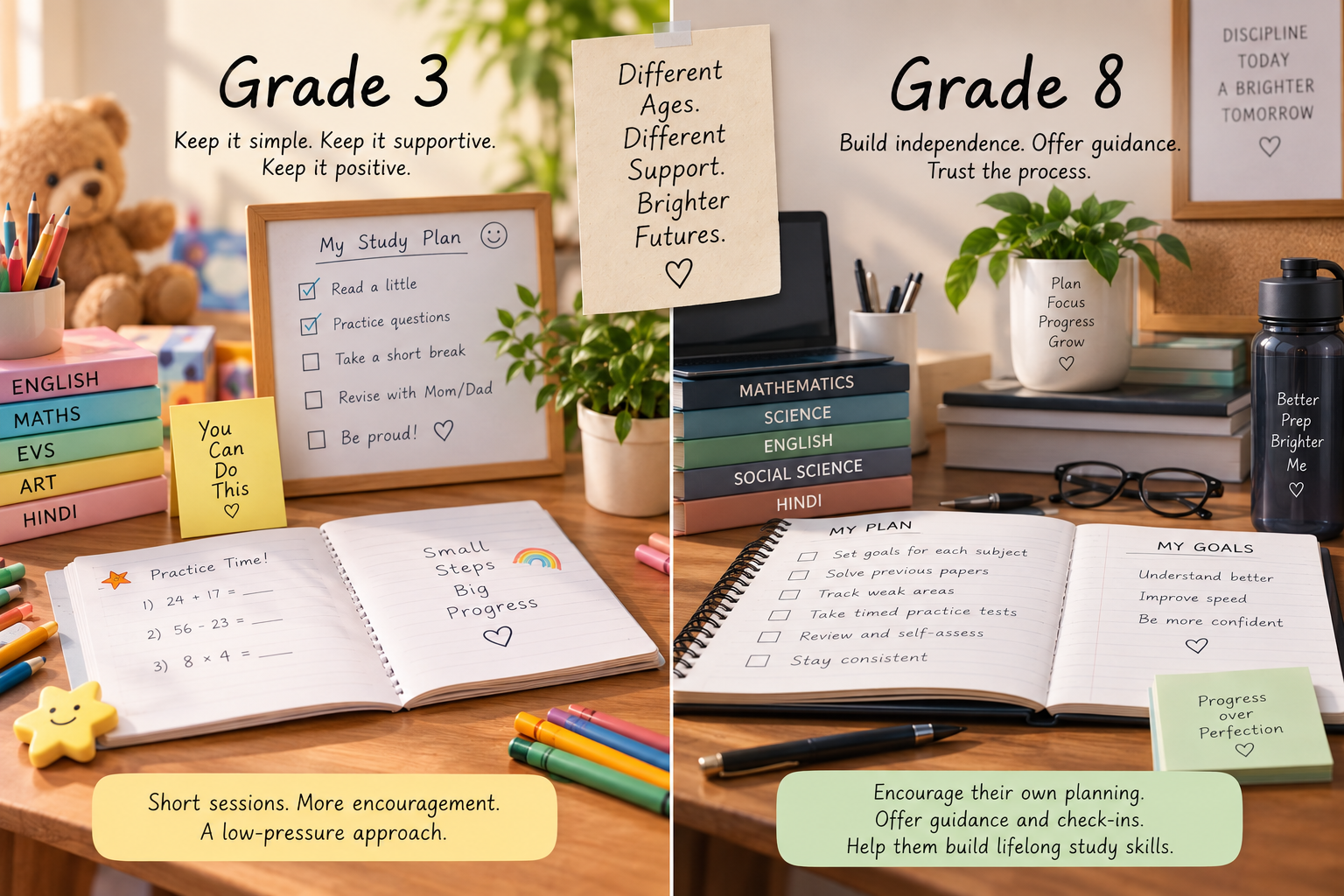
A Grade 3 child’s first experience with a multi-subject assessment calls for a very different approach than a Grade 8 student preparing for a more academically demanding half-yearly exam, and it’s worth calibrating your involvement accordingly.
For younger children, keep the process light, structured, and heavily parent-supported — short, clearly defined study sessions, lots of encouragement, and a genuinely low-pressure framing of what the exam actually is and means.
For older children, gradually shift toward supporting their own independent planning and self-assessment, offering guidance and check-ins rather than directing the process closely. This gradual handover of ownership, done thoughtfully over the middle and senior primary years, builds the kind of independent study skills that become essential by the time board exams arrive in the senior secondary years.
Building a Family Culture Around Effort, Not Just Results
Beyond any single exam, it’s worth thinking about the broader messages your household sends, consistently, about achievement and effort, since these shape a child’s relationship with assessment far more than any single conversation around one particular test.
Notice how effort and results get discussed for things beyond academics too — a sports match, a piece of art, a household task attempted imperfectly. A family culture that consistently values genuine effort and improvement across many different contexts, not just academic marks specifically, tends to produce children who approach exams with healthier, more resilient attitudes than one where academic results carry disproportionate emotional weight compared to everything else.
What a Genuinely Supportive School Does During Exam Season
Schools vary considerably in how they handle the emotional dimension of assessment season, not just the academic content itself.
A genuinely supportive school typically provides clear, advance communication about exam dates, syllabus coverage, and format, reducing the uncertainty that often fuels anxiety. Teachers often build in review sessions and practice opportunities specifically designed to build familiarity and confidence, not just cover content.
Ask directly how your child’s school approaches this, particularly for a grade experiencing its first major assessment — a school that has clearly thought through the emotional as well as academic dimension of this transition is showing genuine care for the whole child, not just their exam performance.
Helping Your Child Process the Result Afterward
However the exam goes, what happens afterward matters just as much as the preparation beforehand, arguably more, for how your child relates to assessment going forward.
If the result is strong, celebrate the effort and process genuinely, not just the outcome, reinforcing that the preparation habits — not luck or innate talent alone — contributed to the result.
If the result falls short of expectations, resist the instinct to immediately problem-solve or lecture. Start instead with acknowledging the disappointment genuinely — “I know this feels disappointing, that’s a completely understandable feeling” — before moving into a calm, collaborative conversation about what might help next time.
Frame every result, strong or disappointing, as useful information about where to focus next, rather than a fixed verdict on ability. This framing, repeated consistently across many exams over the years, genuinely shapes how a child relates to setbacks and challenges well beyond school itself.
Why This First Experience Sets a Pattern
The way a child’s very first significant exam experience is handled, both by the school and at home, tends to establish a pattern that shapes how they approach every subsequent assessment for years to come.
A child who learns early that preparation feels manageable when broken into steady steps, that nervousness is normal and survivable, and that a disappointing result is simply useful information rather than a catastrophe, carries that framework forward into increasingly higher-stakes assessments later — periodic exams, board exams, and eventually, entrance tests and interviews well beyond school.
This is genuinely worth the deliberate attention this first experience deserves, rather than treating it as just one exam among many to get through.
What This Looks Like at Marigold International School
Marigold International School’s approach to assessment reflects its broader NEP 2020-aligned philosophy, aiming to build genuine understanding and steady confidence through the school year, rather than relying on high-pressure, high-stakes testing as the primary measure of a child’s progress.
For families whose children are approaching their first significant assessment, it’s worth asking the school directly how they prepare students both academically and emotionally for this transition, and how the qualitative, holistic elements of the school’s reporting approach, covered in more detail in our companion guide on reading report cards, complement the exam itself in giving a fuller picture of a child’s progress.
Frequently Asked Questions
At what age do children typically start experiencing genuine exam-related nervousness? This varies considerably by child and by how assessments are introduced at a given school, but it commonly becomes noticeable from around Grade 3 or 4 onward, when periodic assessments start carrying more formal weight than earlier classwork.
Should I hire a tutor if my child seems to be struggling with exam preparation specifically? Consider this on a case-by-case basis, depending on whether the struggle is primarily about content understanding, in which case targeted academic support may help, or primarily about anxiety and confidence, in which case the emotional support strategies in this guide may be more directly useful first.
Is it normal for a child to have physical symptoms like stomach aches before an exam? Mild, occasional symptoms are fairly common and not usually cause for alarm, but persistent, significant physical symptoms clustering around exam periods are worth discussing with your pediatrician if they continue over multiple exam cycles.
How much should I help with active study versus letting my child manage it independently? This depends on age and prior experience with structured studying, but generally, aim to help build the study plan and habits collaboratively, gradually shifting toward more independence as your child demonstrates they can manage the process on their own.
What’s the single most helpful thing I can do as a parent during my child’s first major exam season? Stay calm and steady yourself, focus conversations on effort and process rather than only outcome, and make sure your child knows, clearly and consistently, that your support and affection aren’t contingent on the result.
A Final, Honest Note
The first real exam is a genuinely small event in the grand arc of a child’s education, but the pattern it establishes — how preparation feels, how nervousness gets managed, how results get processed — is anything but small in its long-term effect.
Approach it with steady calm, genuine support, and a focus on effort and process over any single result, and you’ll be giving your child something far more valuable than a good score on one particular test.
One last practical tip: after the first major exam is genuinely behind you both, take a moment to reflect together on what worked and what felt harder than expected, while it’s still fresh. This small habit, repeated after each subsequent exam, builds a child’s own self-awareness about their preparation style far more effectively than any advice a parent could offer directly.
Is it normal for a child to feel worse about an exam after it’s over, even if they performed reasonably well? Yes, this is fairly common, particularly for a first significant exam experience, since the anticipation and buildup often feel disproportionate to how the actual exam experience turns out, and some children experience a kind of emotional letdown afterward regardless of the outcome. Give this some gentle space rather than immediately moving on to the next task. A simple, low-key celebration of having gotten through it, regardless of the eventual result, often does more good than immediately shifting focus to the next academic priority. It reinforces that surviving a genuinely nerve-wracking experience is itself worth acknowledging, separate from however the marks eventually turn out. Trust that steady, calm support over time matters far more than getting any single exam season perfectly right.