


Every school website you visit these days mentions “NEP 2020” somewhere on the homepage, usually right next to a photo of smiling children in a science lab.
Ask most parents what it actually means for their child’s daily classroom experience, though, and you’ll get a shrug. It’s become one of those phrases everyone repeats and few people unpack.
This blog unpacks it properly — what NEP 2020 actually changes, what it doesn’t, and how to tell whether a school in south Bangalore is genuinely implementing it or just using it as a marketing line.
What NEP 2020 Actually Is, in Plain Language
The National Education Policy 2020 is India’s first major overhaul of the national education framework in over three decades, replacing the previous 1986 policy.
Its core aim is to shift Indian schooling away from rote memorisation and exam-cramming, toward genuine understanding, critical thinking, and practical application — while also restructuring how school stages themselves are organised.
It applies across boards, not just CBSE, but CBSE schools have been among the most active in visibly restructuring their curriculum and assessment approach around it.
The New 5+3+3+4 Structure
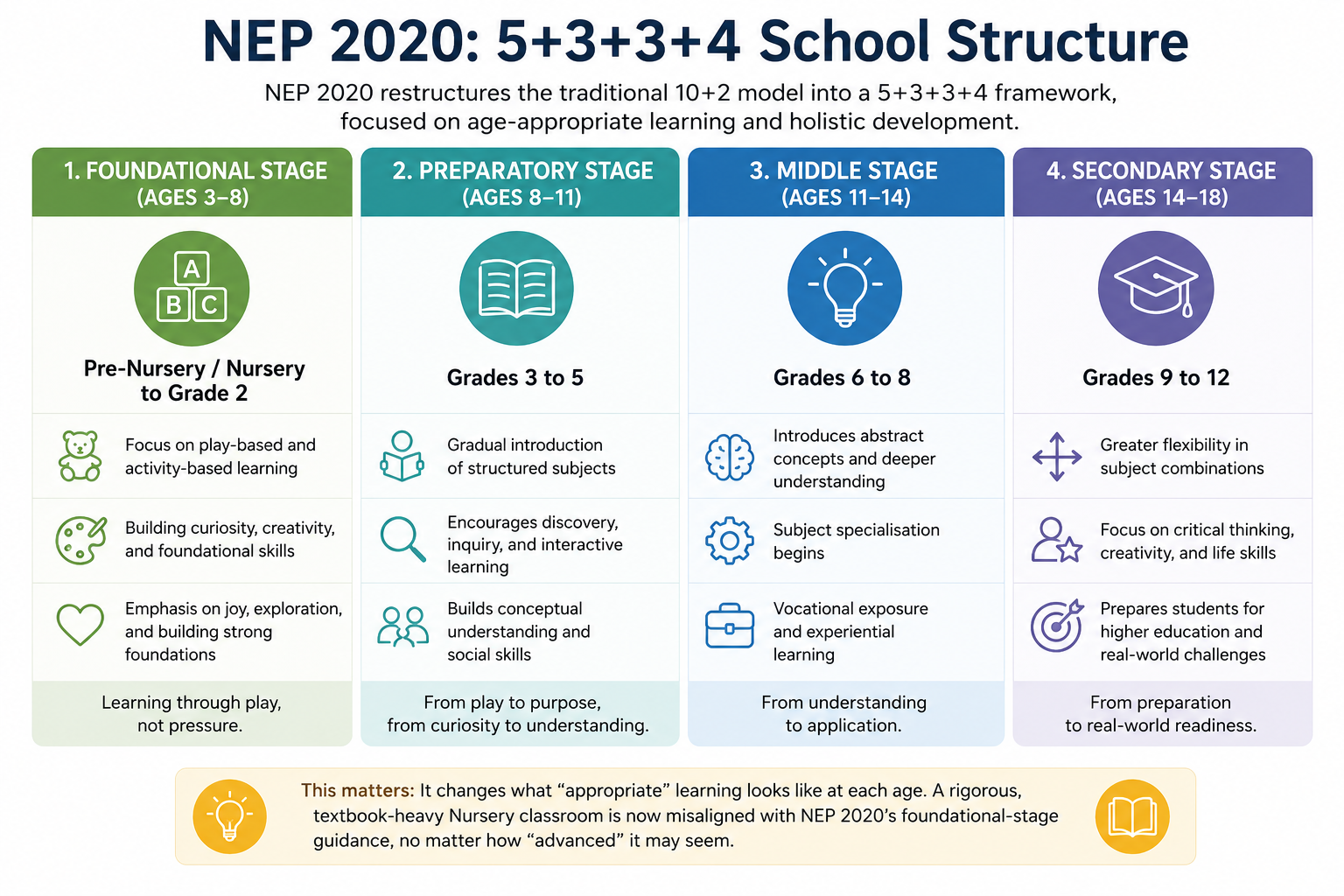
One of NEP 2020’s most concrete changes is restructuring school stages away from the old 10+2 model into a 5+3+3+4 framework:
- Foundational stage (ages 3-8): Pre-Nursery/Nursery through Grade 2, focused on play-based and activity-based learning rather than formal textbook instruction.
- Preparatory stage (ages 8-11): Grades 3 to 5, gradually introducing more structured subjects while still emphasising discovery and interactive learning.
- Middle stage (ages 11-14): Grades 6 to 8, introducing more abstract concepts and subject specialisation, alongside vocational exposure.
- Secondary stage (ages 14-18): Grades 9 to 12, offering greater flexibility in subject combinations rather than rigid streams.
This matters practically because it changes what “appropriate” learning looks like at each age. A rigorous, textbook-heavy Nursery classroom is now explicitly misaligned with the policy’s foundational-stage guidance, regardless of how “advanced” it might look to an anxious parent.
What Changes for Your Child Day to Day
Less emphasis on rote memorisation, more on application. Assessments increasingly test whether a child understands a concept well enough to apply it, not just recall it accurately on demand.
Multilingual exposure from an earlier age. NEP 2020 encourages instruction in the mother tongue or local language wherever feasible in early years, alongside English, rather than an English-only approach from day one.
Vocational exposure starting earlier. From Grade 6 onward, students are meant to get exposure to practical, vocational skills — not to replace academics, but to build real-world competence alongside them.
Reduced subject rigidity at the senior level. Grades 11 and 12 are meant to offer more flexibility in mixing subjects across what used to be strict Science, Commerce, and Arts streams — a student interested in both economics and physics, for instance, has more room to combine them.
More continuous, holistic assessment. Rather than a single high-stakes exam determining everything, NEP 2020 pushes toward ongoing, varied assessment throughout the year, including project work and practical application.
What Doesn’t Change
NEP 2020 doesn’t eliminate board exams, structured curriculum, or academic rigour. It’s not a “no homework, no tests” policy, despite how it’s sometimes casually described in parent WhatsApp groups.
It also doesn’t automatically make every school that mentions it a genuinely transformed institution. Implementation quality varies enormously, and this is exactly where parents need to look past the marketing language.
How to Tell If a School Is Genuinely Implementing NEP 2020
This is the single most useful skill this blog can give you, because nearly every school claims NEP 2020 alignment, and very few explain what that actually looks like in practice.
Ask these specific questions during any school visit:
“Can you walk me through what a Grade 2 day looks like, hour by hour?” A genuinely foundational-stage-aligned classroom should show substantial play-based and activity-based time, not a condensed version of a traditional textbook day.
“How has assessment changed in the last two to three years?” Look for specific examples — project-based assignments, portfolio reviews, reduced weight on single exams — rather than a vague “we focus on overall development.”
“What vocational or skill-based exposure exists from Grade 6 onward?” A genuinely NEP-aligned middle school should have concrete examples: coding, financial literacy, craft-based skills, agriculture exposure, or similar practical modules.
“How much subject flexibility do Grade 11 and 12 students actually have?” Ask for real examples of subject combinations current students have chosen, not just a theoretical policy statement.
“How is the mother tongue or regional language incorporated in early years?” This is often one of the more overlooked aspects of NEP 2020, and a school’s answer here tells you a lot about how seriously they’ve engaged with the full policy, not just the parts that photograph well.
A school with clear, specific, example-driven answers to all five questions has likely done the real work. A school that responds with brochure language to most of them probably hasn’t gone much beyond updating its website.
Why NEP 2020 Implementation Matters More at the Foundational Stage
If your child is currently in the 3-to-8 age range, this is the stage where NEP 2020’s guidance differs most sharply from older, traditional teaching methods — and where the gap between genuine and superficial implementation shows up most clearly.
A foundational-stage classroom that’s still built around worksheets, formal writing drills, and heavy homework for a four-year-old is not aligned with the policy, regardless of what the admissions brochure says.
Watch for play-based corners, activity stations, storytelling-driven lessons, and outdoor learning time when you visit a school’s early-years section. These are the visible markers of genuine foundational-stage implementation.
What This Means for South Bangalore’s School Landscape Specifically
South Bangalore’s newer schools, many built or significantly renovated in the last five to ten years, have had a practical advantage here: they could design classrooms, activity spaces, and curricula around NEP 2020 from the outset, rather than retrofitting an older, more rigid system.
Older, established schools closer to the city centre often have excellent teaching staff and strong legacies, but sometimes face more institutional inertia in fully restructuring around the new framework, simply because change moves slower at scale.
This is genuinely worth asking about directly, regardless of which school you’re considering. Don’t assume newer automatically means better implementation, or that older automatically means outdated — verify with the specific questions above.
Marigold International School has structured its CBSE curriculum explicitly around the NEP 2020 framework from Pre-Nursery onward, with particular emphasis on experiential, activity-based learning in the foundational years — worth experiencing directly during a campus visit if this is a priority in your search.
A Common Parent Worry: “Isn’t Less Rote Learning Going to Hurt My Child in Competitive Exams?”
This comes up constantly, and it’s a fair worry, especially for parents who grew up under a much more exam-drilled system themselves and associate rigour with rote repetition.
The honest answer is nuanced. Competitive exams like JEE and NEET are themselves evolving to test deeper conceptual understanding and application, not just formula recall, which means a genuinely competency-based foundation actually supports strong competitive exam performance later, rather than undermining it.
The risk isn’t NEP 2020 itself — it’s a school implementing a watered-down, unfocused version of it, without maintaining academic rigour underneath the more exploratory teaching style. That’s exactly why the specific verification questions earlier in this guide matter so much. A well-implemented NEP 2020 classroom should still be building strong fundamentals; it’s simply building them through understanding rather than repetition.
How NEP 2020 Affects Extracurriculars and Skill Development
One under-discussed part of NEP 2020 is its emphasis on integrating sports, arts, and vocational skills into the core school day, rather than treating them as optional add-ons squeezed in after academics.
This means, in a genuinely aligned school, physical education, art, and music shouldn’t feel like filler periods. They should carry real weight in the weekly timetable and, increasingly, in how a child’s overall progress is assessed.
Ask any shortlisted school how sports and arts periods are actually weighted in the weekly schedule for your child’s age group, and whether these areas show up meaningfully in report cards, or only as a passing mention.
What Teachers Say About Adapting to NEP 2020
Speaking with teachers directly, rather than admissions staff, often surfaces the most honest picture of how deeply a school has actually adopted the new framework.
Teachers who’ve genuinely shifted their classroom approach usually talk animatedly about specific projects, student-led activities, or changes in how they now structure a lesson. Teachers in schools where NEP 2020 exists mostly on paper tend to describe their day-to-day teaching in much the same terms as they would have five years ago.
If your school visit includes any opportunity to briefly speak with a teacher, even informally, ask them directly: “What’s changed in how you teach since NEP 2020?” Their answer, and how readily it comes, tells you a great deal.
A Simple Parent’s Glossary for NEP 2020 Terms You’ll Hear
Foundational Literacy and Numeracy (FLN): The push to ensure every child achieves basic reading and maths competency by around Grade 3, seen as a critical building block for everything after.
Competency-Based Education: Learning measured by whether a child can actually apply a skill or concept, not just recall it for an exam.
Holistic Progress Card: A more detailed, multi-dimensional report card format encouraged under NEP 2020, covering skills and development beyond just subject marks.
Experiential Learning: Learning through direct experience — experiments, projects, real-world tasks — rather than passive lecture-and-notes instruction.
Multidisciplinary Education: Encouraging students, especially at the senior level, to combine subjects across traditional stream boundaries.
Knowing these terms helps you ask sharper, more specific questions on your next school visit, instead of nodding along to language you don’t fully have a handle on.
Why Some Schools Move Faster Than Others on Implementation
It’s a fair question: if NEP 2020 was announced in 2020, why do implementation levels still vary so widely across schools years later?
Part of the answer is structural. Retraining an entire existing teaching staff, redesigning assessment systems, and physically reconfiguring classrooms for activity-based learning is a genuinely large undertaking for an established school with hundreds or thousands of existing students mid-journey through the old system.
Newer schools, building their teaching culture and physical spaces from scratch, don’t carry that transition burden in the same way — they can design directly around the new framework from day one, rather than retrofitting it onto an existing structure built for a different era of schooling. This is one honest, practical reason implementation quality often correlates loosely with how recently a school was established or renovated, though it’s never a guarantee on its own.
Setting Realistic Expectations at Home
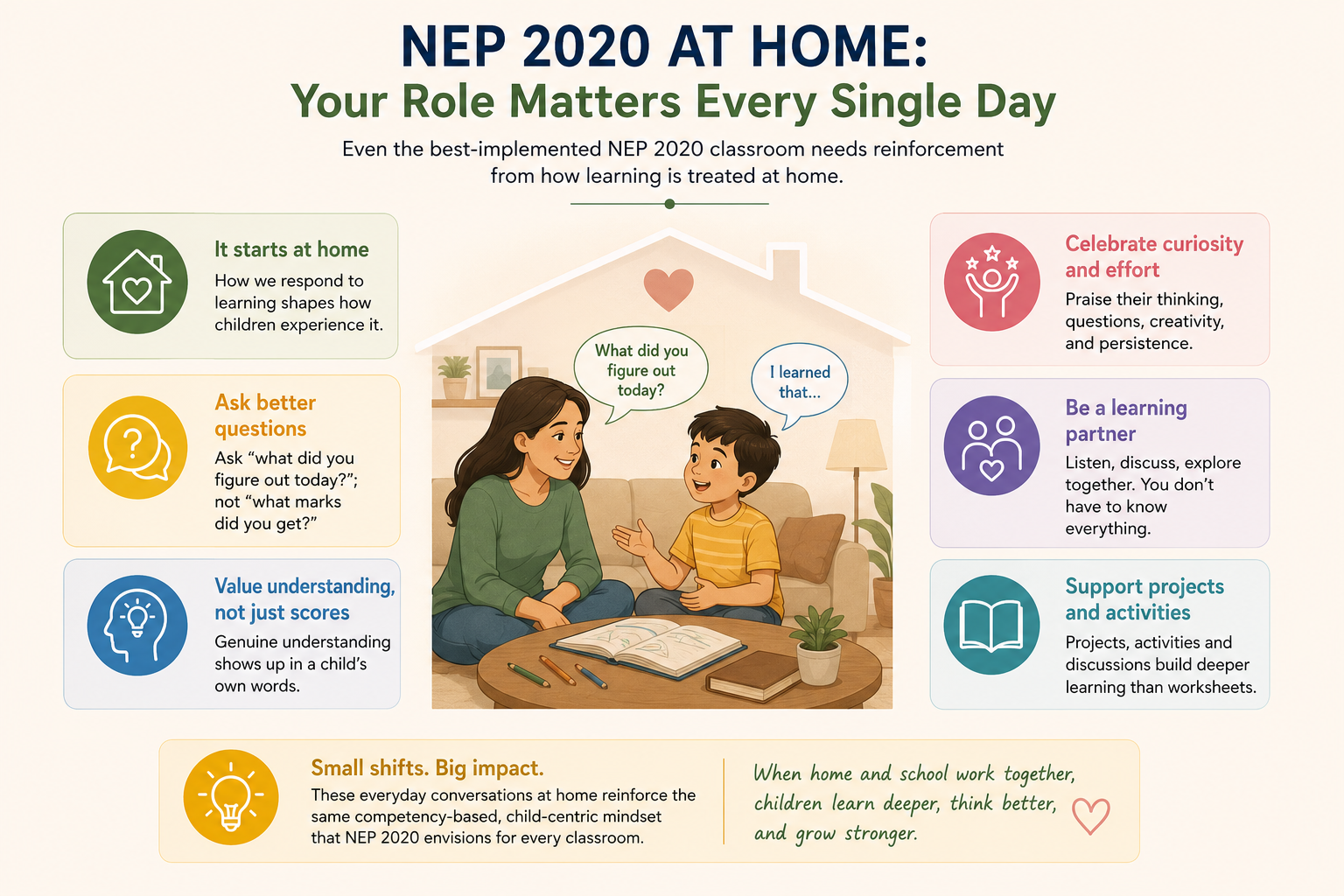
Even the best-implemented NEP 2020 classroom needs reinforcement from how learning is treated at home, and this is worth a moment of honest reflection for parents too.
If a child comes home talking about a project or activity instead of a stack of completed worksheets, resist the instinct to worry that “nothing is being taught.” Ask them to explain what they learned and how — genuine understanding usually shows up clearly in a child’s own words, often more clearly than a worksheet full of correct answers ever would.
Small shifts help too: asking “what did you figure out today” instead of “what marks did you get” nudges the same competency-based mindset the policy is built around, right into your daily conversations at home.
Should NEP 2020 Alignment Be a Deciding Factor?
It’s an important factor, but not the only one. A school with strong, genuine NEP 2020 implementation but weak safety practices or poor communication is still not the right choice.
Use it as one lens among several — alongside campus quality, commute, safety, and fees — covered together in our companion guide on choosing the best CBSE school in south Bangalore.
What NEP 2020 alignment does tell you, reliably, is whether a school is actively evolving its teaching approach or coasting on an older model. That, on its own, is valuable information about the kind of institution you’d be entrusting your child to for over a decade.
A Final, Honest Note
NEP 2020 is, at its core, an attempt to make school feel less like an exam factory and more like a place where genuine understanding and curiosity are built, one year at a time.
Whether it succeeds for your specific child depends entirely on how seriously the school you choose has actually implemented it, not on the policy document itself. Ask the specific questions in this guide, watch an actual classroom in action if you can, and let the answers, not the buzzwords, guide your decision.
Frequently Asked Questions
Is NEP 2020 only relevant to CBSE schools? No, it applies across boards, though CBSE schools have generally been the most visible in restructuring around it, partly due to closer alignment with central government education directives.
Does NEP 2020 mean less homework for young children? It generally encourages reduced formal homework in the foundational stage, favouring play-based and activity-based learning instead, though implementation varies by school.
How can I verify a school’s NEP 2020 claims beyond their website? Ask specific, example-based questions during a campus visit, as outlined above, and request to observe an actual classroom session for the relevant age group.
Will NEP 2020 change how board exams work? It pushes toward more continuous and holistic assessment throughout the year, alongside board exams, rather than replacing final board exams entirely.
Is it worth prioritising a school specifically because of strong NEP 2020 implementation? Yes, particularly for younger children in the foundational stage, since it directly affects how developmentally appropriate their daily classroom experience will be.
One last practical tip: if a school offers an open classroom observation day for prospective parents, take it, even if it means rearranging your schedule. Fifteen minutes watching a real lesson unfold will tell you more about genuine NEP 2020 implementation than any conversation with an admissions counsellor possibly can.
And a broader thought to sit with: policy documents change slowly, but classrooms change one teacher, one lesson plan, one committed principal at a time. The best sign of genuine NEP 2020 implementation isn’t a framed certificate in the reception area — it’s a school that keeps visibly evolving its methods year after year, rather than treating any single policy update as a finished project.
One more angle worth considering: talk to parents whose older children have already moved through the foundational and preparatory stages at a school claiming NEP 2020 alignment. Ask them, honestly, whether they noticed a real shift in how their child approached learning, curiosity, and confidence over those years, compared to what they remember from their own schooling. Lived parent experience, gathered directly rather than through a testimonial page, remains one of the most reliable ways to separate genuine implementation from marketing language.