


The first parent-teacher meeting of a new academic year has a particular kind of nervous energy to it, and it’s not just the children who feel it.
You’ve dropped your child off every morning for a couple of months now. You’ve heard fragments of stories over dinner — a friend’s name, a complaint about too much homework, an excited mention of a new activity. But you haven’t yet sat across from the person who actually sees your child for six or seven hours a day, five days a week.
For families across Kengeri, Uttarahalli, RR Nagar, and the Mysore Road belt heading into this term’s meetings, here’s how to make the most of those fifteen or twenty minutes, rather than leaving with only “doing well, no concerns.”
Why the First Meeting Matters More Than It Seems
Early in the year, a teacher is still forming their picture of your child — how they learn, what motivates them, where they might need a nudge. This first meeting is genuinely a two-way exchange, not just a report on how your child is doing so far.
What you share here — your child’s temperament, what’s worked for them in the past, any concerns from a previous school or transition — genuinely shapes how a teacher understands and works with your child for the rest of the year. Treat it as an opportunity to build a real partnership, not just a formality to get through.
Before the Meeting: A Little Preparation Goes a Long Way
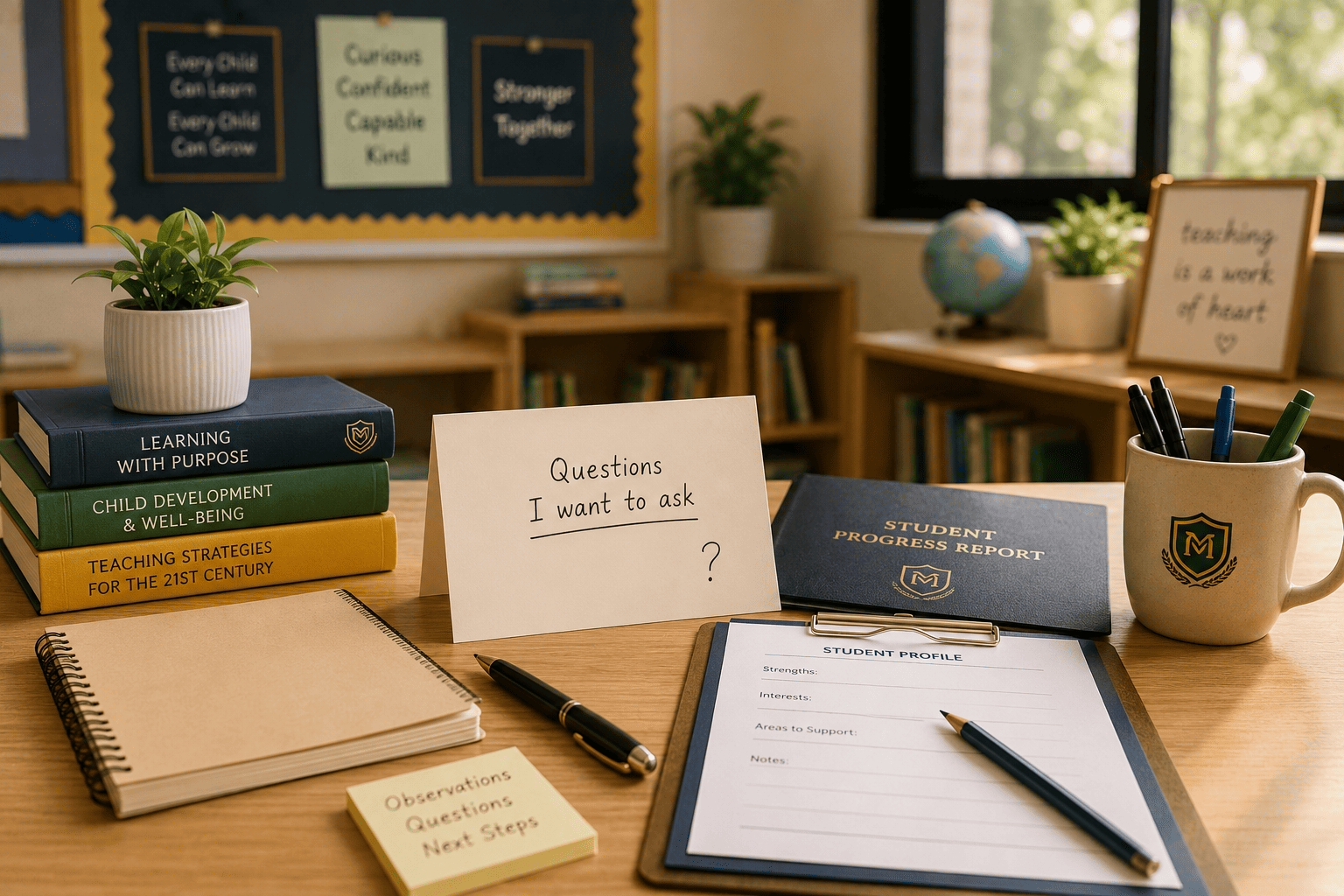
Walking in with two or three specific things you want to discuss makes a fifteen-minute slot far more useful than walking in and simply asking “how’s everything going?”
Jot down anything specific you’ve noticed at home — reluctance around a particular subject, a change in mood after school, a friendship that seems important to your child, or simply things they’ve mentioned enjoying. These small details help a teacher connect classroom behaviour with what’s happening in your child’s broader life.
If your child has moved from another school recently, it’s worth mentioning anything from that transition that might still be settling — a different teaching style they were used to, a friend group they miss, or anything that made the previous environment feel comfortable that you’d like this teacher to know about.
Questions Worth Asking Beyond “How Is My Child Doing?”
That question rarely produces much beyond a pleasant, general answer. These get you further.
“What does my child do when they don’t understand something?” This reveals a lot about independence and confidence — does your child ask for help readily, or quietly disengage?
“Who does my child sit with, or gravitate toward, during free time?” Social comfort matters enormously for how well a child settles into a new grade or new school, and teachers often notice patterns parents don’t get to see.
“Is there a subject or activity where my child seems especially engaged?” This can surface strengths and interests worth nurturing at home too, sometimes ones you hadn’t noticed yourself.
“Is there anything my child does in class that surprises you, compared to what you might expect from talking to me?” Children often behave differently at school than at home, and this question can reveal a side of your child you don’t usually see.
“What’s one small thing I could reinforce at home that would help right now?” A specific, actionable answer here is far more useful than a general “just keep encouraging reading.”
Questions Specific to a Newer or Transitioning Child
If your child recently joined this school, whether at the start of the year or mid-year, a few additional questions are worth raising directly.
Ask how your child’s settling-in process compares to what the teacher typically sees — are they adjusting at a normal pace, faster, or do they seem to need more time and support than most children in a similar situation?
Ask specifically about friendships, since this is often the single biggest factor in how quickly a child feels genuinely comfortable in a new environment, more so than academic adjustment in the early weeks.
What to Do If You Hear Something Concerning
If a teacher raises a genuine concern — academic, social, or behavioural — resist the instinct to become defensive or to immediately minimise it. Teachers generally raise concerns because they want to solve something collaboratively, not because they’re assigning blame.
Ask specific follow-up questions: how long has this been noticed, is it consistent or occasional, and what has the teacher already tried in the classroom? Then ask what you can specifically do at home to support the same approach, so the response is consistent between school and home rather than working at cross purposes.
What to Do If Everything Sounds Great
It’s tempting to relax entirely if a teacher reports no concerns at all, but it’s worth digging one layer deeper even in a positive conversation.
Ask what would meaningfully challenge or stretch your child further, given how well things are going. A good teacher will often have specific thoughts here — an area worth exploring, a slightly more advanced project, a leadership opportunity within the classroom — that can turn a “no concerns” conversation into a genuinely useful one.
Bringing Your Child Into the Conversation Afterward
However the meeting goes, it’s worth having a light, positive conversation with your child afterward, appropriate to their age.
For younger children, simply sharing one specific, genuine positive from the meeting — “your teacher told me you’ve been really kind to a new student” — reinforces good behaviour without making the meeting feel like a formal evaluation being reported back to them.
For older children, particularly from around Grade 5 or 6 onward, involving them more directly in understanding what was discussed, including any areas for growth, helps build the same self-awareness and ownership that a strong life-skills curriculum aims to develop more broadly.


A Real Scenario Worth Recognising
Consider a fairly common pattern: a parent walks into the first meeting expecting to hear about academics, and instead learns their child has been struggling to make friends, something that hadn’t come up at all in dinner-table conversations at home.
This isn’t unusual. Many children, especially those newer to a school or naturally more reserved, don’t easily share social struggles with parents, even while the same struggles are quite visible to a teacher observing classroom and playground dynamics daily.
If this happens, resist the urge to immediately problem-solve on the spot. Ask the teacher what they’ve observed specifically, whether it seems to be improving or getting worse over the weeks, and what small, low-pressure things you might do at home — without turning it into an interrogation your child will sense the moment they get home.
Preparing Your Child for the Idea of Parent-Teacher Meetings
For a child new to the concept, especially a younger one, it helps to briefly explain what a parent-teacher meeting actually is, framed positively rather than as something to be anxious about.
A simple explanation works well: “Your teacher and I are going to talk about how school is going for you, and how we can help you have an even better year.” This keeps the tone collaborative rather than evaluative, and reduces any anxiety a child might otherwise build up around the idea of being “discussed” by adults.
Avoid framing it as a report card moment or something to worry about in advance. Most children, when the meeting is described this way, don’t think much about it at all beforehand, which is exactly the right amount of concern for a child to carry into a routine part of the school year.
What Different Age Groups Need From These Meetings
A Nursery or LKG parent-teacher conversation looks very different from one for a Grade 6 or 7 student, and it’s worth adjusting your expectations and questions accordingly.
For the youngest children, focus heavily on settling-in signs — comfort with routine, toilet independence if relevant, eating habits at school, and social comfort — since academic content matters far less at this stage than emotional and practical adjustment.
For middle and senior primary children, balance academic questions with social and emotional ones, since this is often when friendship groups solidify and academic expectations start to meaningfully increase together.
For middle school and beyond, increasingly involve your child in understanding what’s discussed, and shift toward questions about independence, self-management, and how they’re handling increasing academic responsibility on their own.
Making the Most of a Short Time Slot
Most parent-teacher meetings run fifteen to twenty minutes, and with a full schedule of appointments, teachers are often managing a tight timeline across an entire afternoon or evening. A few practical habits help you use that time well.
Arrive on time, and be mindful of families waiting after you. If you have a genuinely complex concern that needs more than the allotted slot, it’s usually better to flag it briefly and ask for a separate, longer follow-up conversation rather than trying to compress a serious discussion into the last two minutes of your slot while the next family waits.
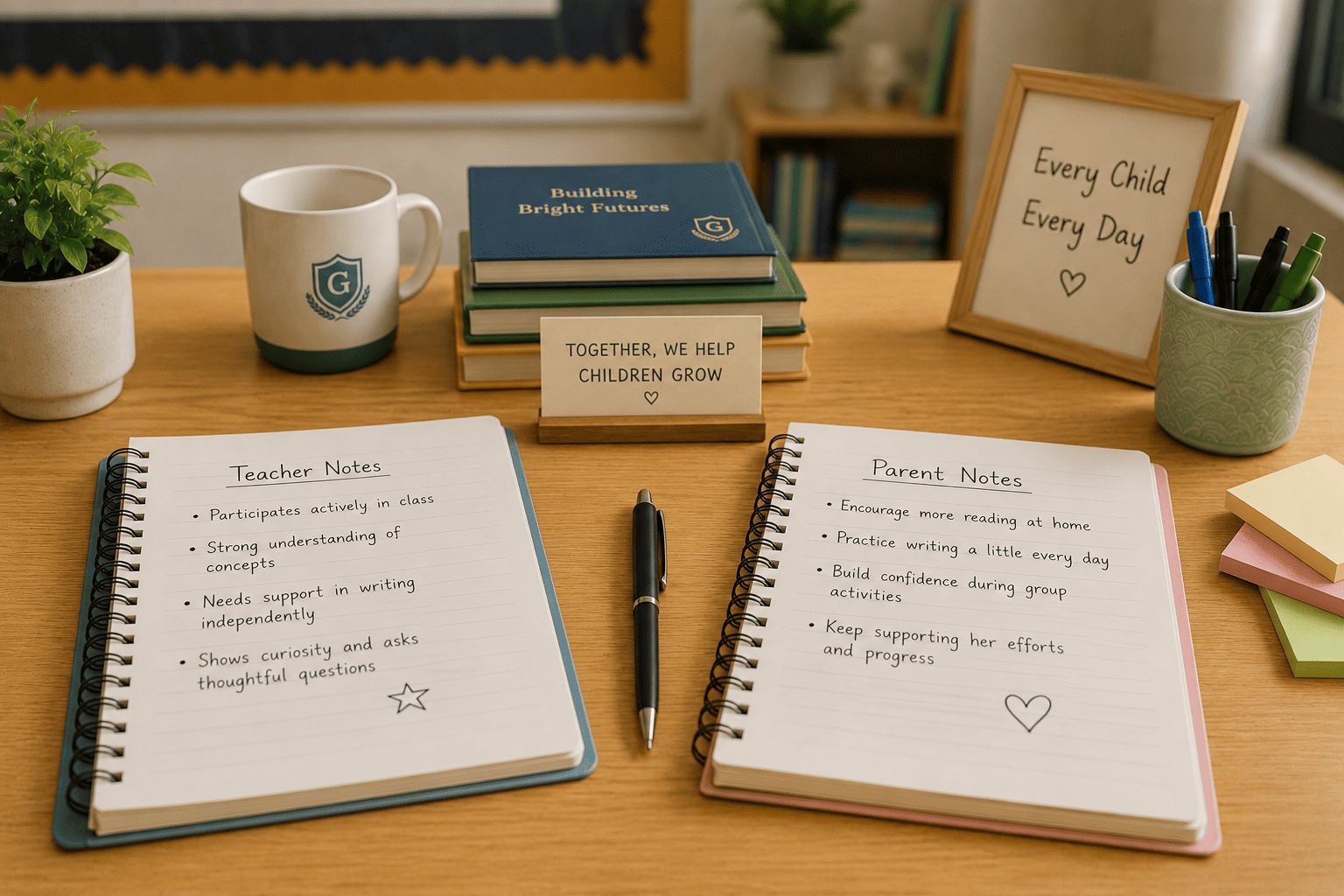
Take a few notes during or immediately after the meeting. Specific details — a book recommendation, a particular concern to watch for, an activity your child enjoyed — are easy to forget once the day gets busy again.
Why Consistent Communication Beyond This One Meeting Matters More
A single parent-teacher meeting, however good, is only one data point across a full academic year. The real value comes from ongoing, consistent communication between these formal meetings.
Ask what communication channels the school uses between scheduled meetings — a parent app, regular newsletters, or a straightforward way to reach out if something comes up unexpectedly. A school that makes this genuinely easy, rather than only formal and infrequent, supports a much stronger year-round partnership between home and classroom.
What This Looks Like at a School That Takes Communication Seriously
Schools that build strong home-school communication into their culture tend to treat the first parent-teacher meeting as the start of an ongoing conversation, not an isolated checkbox exercise repeated twice a year.
At Marigold International School, this approach is reflected in how teachers are encouraged to maintain regular, specific communication with parents throughout the term, not only during scheduled meeting slots, and in how the school’s structure — smaller, more personal class groupings within its stage-wise curriculum approach — supports teachers genuinely knowing each child well enough to have a substantive conversation, not a generic one.
Frequently Asked Questions
How long before the first parent-teacher meeting should I start observing my child at home for specific things to mention? A couple of weeks of paying closer attention is usually enough to notice genuine patterns worth raising, rather than one-off moments that may not be representative.
What if I disagree with something the teacher says about my child? Share your perspective calmly and specifically, using examples from home, rather than dismissing the teacher’s observation outright. Often, a child genuinely does behave differently in the two settings, and both perspectives add up to a fuller picture.
Should both parents attend if possible? It’s not essential, but if both parents can attend, it often means fewer follow-up conversations are needed to relay information accurately, and it signals a shared level of engagement that most teachers appreciate.
Is it appropriate to ask about other students or classroom dynamics? You can ask general questions about your child’s social environment, but avoid asking for specifics about other individual children, which most teachers won’t be able to share for privacy reasons.
What should I do if the meeting feels rushed and I didn’t get to ask everything I wanted? Politely ask for a follow-up conversation, either a quick call or a slightly longer slot on another day, rather than trying to squeeze an important discussion into the final minute of an already tight schedule.
When You Can’t Attend in Person
For working parents, particularly those balancing demanding jobs along the Mysore Road or wider south Bangalore commute belt, attending an in-person meeting during a weekday isn’t always possible.
Ask whether the school offers a phone or video call option as an alternative, rather than simply skipping the meeting altogether. Most schools that take communication seriously will accommodate this, understanding that a parent’s genuine engagement matters more than the format it takes.
If a call is the only option, prepare for it exactly as you would an in-person meeting — the same specific questions, the same note-taking, the same follow-up with your child afterward. The format matters far less than the substance of the conversation itself.
A Final, Honest Note
A parent-teacher meeting is a small window of time, but it’s one of the most direct ways you get to understand how your child experiences a huge part of their daily life, one you don’t otherwise get to see firsthand.
Walk in prepared, ask specific questions, listen more than you speak, and treat it as the start of an ongoing conversation rather than a single verdict on how the year is going.
One last practical tip: if your school offers a choice of meeting slots, pick a time when you won’t be rushing in from somewhere else or rushing off immediately after. Even fifteen minutes of unhurried, present conversation yields far more than twenty distracted ones.
Why This Habit Compounds Over the Years
Parents who treat every parent-teacher meeting, not just the first one, as a genuine two-way conversation tend to build a noticeably stronger working relationship with their child’s teachers over the years, one where small issues get raised and resolved early rather than accumulating unnoticed.
This compounds meaningfully by the time a child reaches the more academically demanding senior years, when the trust and communication habits built in the early primary grades make it far easier to navigate genuinely higher-stakes conversations about subject choices, exam stress, or college planning down the line.
How can I tell if a school genuinely encourages this kind of ongoing partnership, rather than treating meetings as a formality? Look at how easy it is to reach a teacher outside scheduled meetings, how specific their communication tends to be, and whether concerns raised in one meeting are visibly followed up on in the next, rather than starting from scratch each time. Ask current parents directly about their experience with this before enrolling, since it’s one of the harder things to judge from a single campus tour.
That consistency, more than the warmth of any single conversation, is what genuinely distinguishes a school that values home-school partnership from one that simply schedules meetings because the calendar requires it. It’s worth paying attention to over your child’s first full year, not just judging from a single positive first impression. A single great meeting is encouraging; a full year of consistent, specific communication is proof.