


Every September 8th, World Literacy Day passes quietly through most school calendars, usually with a small assembly or a classroom activity, and then everyone moves on to whatever comes next in the term.
It’s worth pausing on this one a little longer than most, because reading habits, more than almost any other single factor, tend to predict a child’s long-term academic and even professional trajectory. A child who genuinely loves reading has, in a very real sense, a self-sustaining engine for learning that keeps running long after any specific school lesson ends.
This guide is about what actually builds that habit, and what to look for in a school that takes it seriously, beyond the occasional literacy-themed assembly.
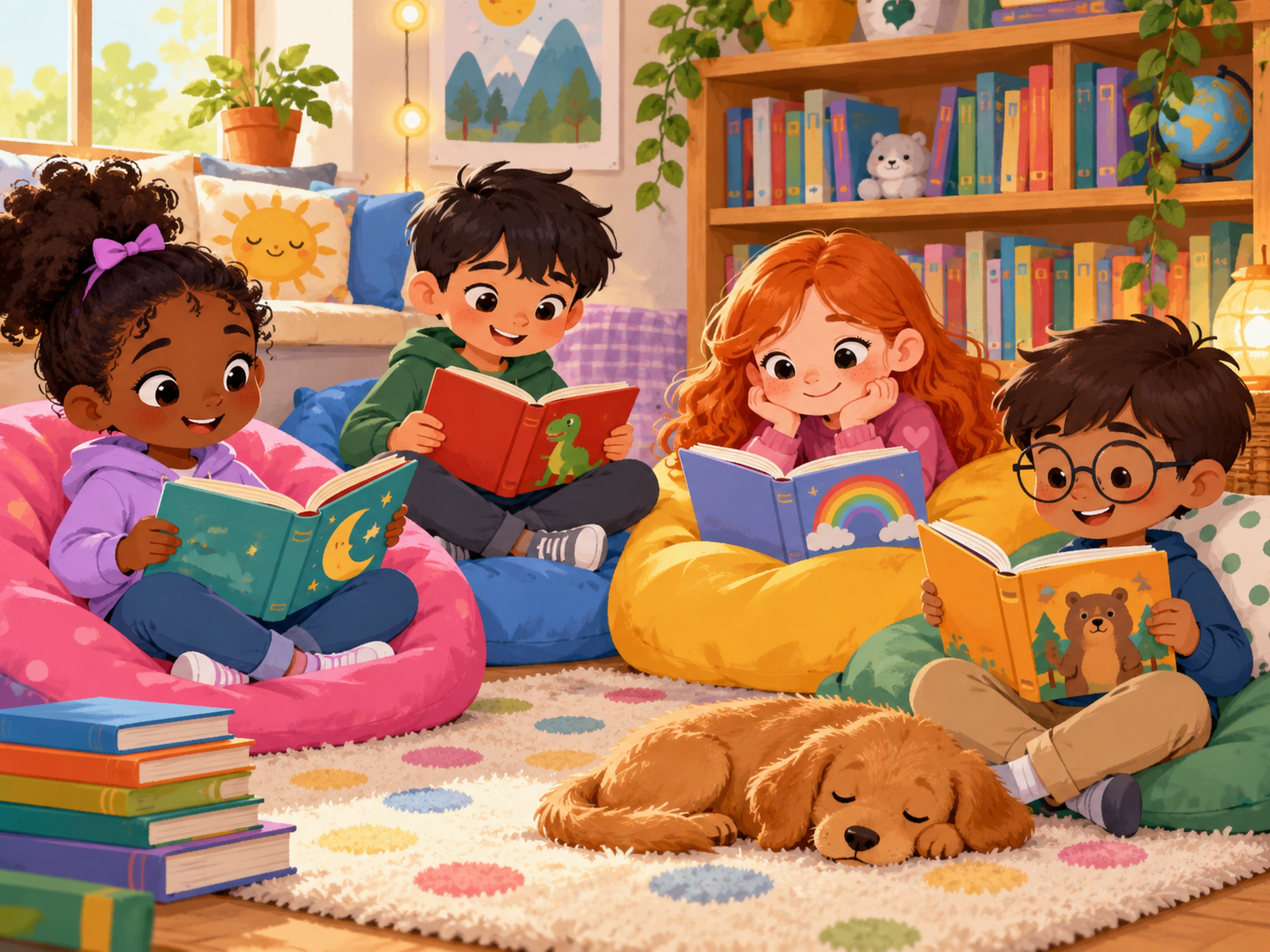
Why Reading Habits Matter More Than Reading Ability Alone
There’s an important distinction worth making upfront: a child can be technically capable of reading — able to decode words accurately and understand basic comprehension questions — without genuinely being a reader, someone who chooses to read for pleasure and curiosity rather than only when required to.
Reading ability is what schools primarily assess. Reading habit is what actually compounds over years, building vocabulary, general knowledge, empathy, and critical thinking in ways that ripple into every other subject, not just language class specifically.
This is why a school’s approach to building genuine reading habits deserves separate attention from how well it teaches reading mechanics, even though the two are obviously connected.
What the Research Actually Shows About Reading for Pleasure
t’s worth grounding this in more than intuition. Studies consistently link regular reading for pleasure, particularly established during childhood, with stronger vocabulary development, better academic performance across subjects, not just language-based ones, and even measurable benefits for empathy and social understanding, since fiction in particular exposes children to perspectives and experiences beyond their own immediate life.
This matters because it reframes reading time not as a “nice to have” alongside more serious academic work, but as a genuinely high-leverage investment in a child’s overall development, worth protecting deliberately in an increasingly busy schedule.
What Genuinely Effective Schools Do to Build Reading Habits
A well-stocked, genuinely inviting library, not just a room with books. The physical experience of a library matters more than parents sometimes realise — comfortable seating, an inviting layout, and a collection that includes genuinely engaging, age-appropriate fiction, not just reference material and textbooks.
Dedicated, protected reading time within the school day, not just homework assigned to be done independently at home. A period specifically set aside for reading, without the pressure of an accompanying assignment or assessment, signals that reading itself is valued, not just reading-related tasks.
Book choice and autonomy, particularly as children get a little older. A child forced to read only from a narrow, prescribed list often builds resentment rather than genuine enjoyment, while meaningful choice within age-appropriate parameters builds ownership and intrinsic motivation.
Teachers and librarians who model genuine enthusiasm for reading themselves, recommending books with real excitement rather than simply assigning them as a task. Children pick up on genuine enthusiasm far more readily than on obligation.
Regular exposure to a variety of formats and genres — fiction, non-fiction, poetry, graphic novels — recognising that different children connect with different formats, and that all of them build genuine literacy skills, not just traditional prose fiction.
Why Graphic Novels and “Easier” Books Deserve More Respect Than They Get
It’s worth specifically addressing a common parental worry: that a child gravitating toward graphic novels, simpler chapter books, or re-reading familiar favourites repeatedly isn’t “really” reading in a meaningful sense.
This concern, while understandable, often does more harm than good. Graphic novels build genuine literacy skills, including inference and visual literacy, and often serve as a crucial bridge for reluctant readers toward more text-heavy material later. Re-reading a beloved book repeatedly builds fluency, comfort, and genuine, sustaining love for the reading experience itself, which matters more at a young age than constantly pushing toward more “advanced” material.
The goal, particularly in the early years, is building genuine enthusiasm and comfort with reading as an activity, not optimising for the most sophisticated possible reading list at the earliest possible age.
How to Build Reading Habits at Home
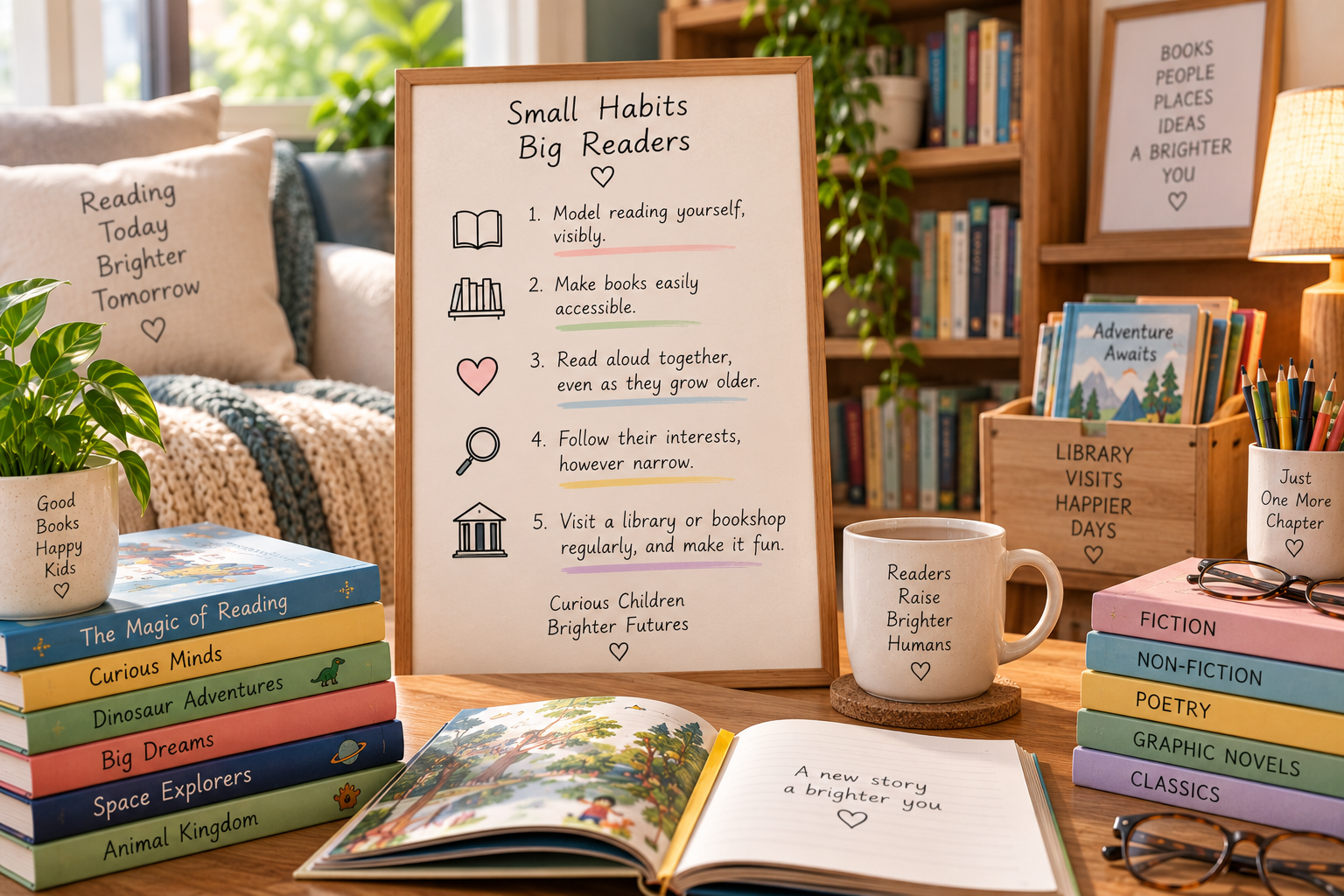
Model reading yourself, visibly. Children notice when reading is something adults genuinely do for pleasure, not just something they’re told to do. A household where a parent is regularly seen reading for enjoyment sends a powerful, wordless message.
Make books easily, physically accessible. A child is far more likely to pick up a book that’s within easy reach — on a low shelf, on a bedside table, in the car — than one that requires a deliberate trip to find.
Read aloud together, even past the age when your child can read independently. Shared reading builds connection and exposes children to slightly more advanced vocabulary and story structure than they might tackle entirely on their own, while also simply being a genuinely enjoyable shared activity.
Follow your child’s interests, even if they feel narrow. A child obsessed with dinosaurs, football, or a specific fantasy series is building genuine reading stamina and vocabulary, even if the material feels repetitive to you as a parent. Depth within a genuine interest often builds more lasting habit than breadth across material a child doesn’t actually enjoy.
Visit a library or bookshop regularly, treating it as an enjoyable outing rather than a chore. The experience of browsing and choosing builds genuine ownership over reading in a way that assigned books alone don’t.
Navigating Screen-Based Reading
It’s worth addressing this directly, since it’s an increasingly common source of parental uncertainty: does reading on a screen — an e-reader, a tablet, an educational app — count as genuine reading, or does it undermine the habit you’re trying to build?
The honest answer is nuanced. Reading is reading, in terms of the core cognitive skills being built, regardless of format, though screen-based reading does come with some specific considerations — the potential for distraction from notifications or other apps, and the general concerns around screen time before bed covered in our companion guide on homework, screen time, and sleep.
If screen-based reading is genuinely engaging your child and building the habit, it’s reasonable to embrace it as one legitimate format among several, while still protecting some dedicated physical-book reading time too, particularly closer to bedtime when screen-free reading supports better sleep.
A Real Scenario Worth Recognising
Consider a common pattern: a Grade 3 child who reads fluently and scores well on comprehension tests but never voluntarily picks up a book during free time, always choosing other activities instead when reading isn’t required.
This is worth taking seriously as a distinct concern from reading ability, since it suggests the mechanical skill has developed without the accompanying genuine enjoyment. Often, digging a little deeper reveals the issue is a mismatch between what the child has been assigned to read and what would genuinely interest them — perhaps a classroom reading list weighted heavily toward material that doesn’t connect with this particular child’s interests or reading level preferences.
Introducing a deliberate, unstructured trip to a library or bookshop, with genuine freedom to choose anything at all that catches their interest, regardless of how a parent might judge the selection, sometimes shifts this pattern meaningfully. The goal at this stage is rebuilding association between reading and genuine choice and enjoyment, rather than continuing to add more assigned or “improving” material to an already skill-adequate but enthusiasm-lacking reader.
How Reading Habits Connect to Performance Across Every Subject
It’s worth making this connection explicit, since it’s easy to think of reading purely as a language-arts concern, separate from maths, science, or other subjects.
Strong reading comprehension directly affects a child’s ability to understand word problems in mathematics, follow multi-step instructions in a science experiment, and engage meaningfully with textbook material across every subject area, not just literature specifically. A child who reads confidently and widely tends to have an easier time with the language demands embedded in every other subject, even ones that don’t feel explicitly “reading-focused.”
This is one of the more compelling, practical reasons to treat reading habit-building as a genuine priority rather than a soft, secondary concern — the compounding benefit extends well beyond the English or language class itself, quietly supporting performance across the entire curriculum.
Building a Family Reading Culture Beyond Just Your Child
It’s worth thinking about reading culture as a whole-family practice rather than something that applies only to your child’s individual habit-building. Siblings reading together, even at different levels, shared family trips to a bookshop or library, and household conversations about books everyone is currently reading all reinforce the same underlying message: reading is something this family genuinely values and enjoys together, not just an academic requirement imposed on the youngest members.
Consider setting aside a small, regular family reading time — even fifteen minutes on a weekend morning, everyone reading their own book in the same room — as a low-pressure, enjoyable ritual rather than an additional obligation squeezed into an already busy schedule.
What to Do If Your Child Genuinely Doesn’t Enjoy Reading
Some children, despite every reasonable effort, simply don’t take to reading as readily or as early as others, and it’s worth approaching this with patience rather than escalating pressure, which tends to backfire.
Explore whether the difficulty is about reading mechanics themselves — a child who finds decoding genuinely effortful is unlikely to enjoy an activity that feels like hard work, and this is worth discussing with the school if it seems to be a persistent pattern, since targeted support can make a real difference here.
If mechanics aren’t the issue, focus on finding the right material rather than assuming the child simply isn’t a “reader.” The right book, matched to genuine interest and the right level of challenge, has turned many reluctant readers into enthusiastic ones, sometimes quite suddenly, once the right match is found.
Avoid framing reading as a battle or a source of ongoing conflict at home. A child who associates reading primarily with parental frustration and pressure is less likely to develop genuine enjoyment than one given patient space and the right material to discover it on their own timeline.
Why This Deserves Attention When Evaluating a School
When comparing schools, library and reading culture rarely feature as prominently in parent conversations as academics, sports facilities, or fees, but it’s worth deliberately adding to your evaluation, given how much it compounds over a child’s entire school journey.
Ask specifically about the library — its size, how frequently children visit, whether visits are structured with dedicated browsing time or simply attached to a specific curriculum requirement, and how the collection is curated and refreshed over time.
Ask about dedicated reading time within the weekly timetable, distinct from language class specifically, and ask how younger children in particular are introduced to the joy of reading, not just the mechanics of it.
What This Looks Like at Marigold International School
Marigold International School’s approach to building reading culture reflects its broader NEP 2020-aligned philosophy, treating reading for pleasure as a genuine, protected part of a child’s week, not an afterthought squeezed in around more formally assessed academic content.
For families evaluating this specifically, it’s worth visiting the library in person during a campus tour, observing how it’s used by children during an ordinary school day if possible, rather than relying solely on a description of the collection’s size.
Frequently Asked Questions
At what age should independent reading for pleasure typically start? This varies by child, but most children who’ve had regular exposure to books and reading aloud from an early age begin showing genuine interest in independent reading somewhere between ages six and eight, though the timeline varies considerably and isn’t a cause for concern within a reasonable range.
Is it a problem if my child only wants to reread the same books repeatedly? Not at all — this is a normal, healthy pattern that builds fluency, comfort, and genuine attachment to reading, and it typically resolves naturally into broader exploration once the child feels ready, without needing to be pushed.
How can I tell if my child’s reading struggles are about mechanics versus lack of interest? Watch whether they engage happily when a book is read to them, even if they resist reading independently. If listening comprehension and enjoyment are strong but independent reading feels effortful and frustrating, mechanics are likely the primary issue, worth discussing with the school.
Should I limit which genres or types of books my child reads? Generally, it’s more effective to follow genuine interest, within basic age-appropriateness, than to restrict genres based on personal preference, since building the underlying habit and love of reading matters more at a young age than curating a particular kind of reading list.
How much should schools be responsible for building reading habits versus parents? Both matter significantly and work best together — a school with strong library culture and protected reading time, combined with a home environment that models and supports reading, produces far stronger outcomes than either alone.
A Final, Honest Note
A genuine love of reading is one of the most durable gifts a childhood can build, quietly supporting a child’s curiosity, vocabulary, empathy, and academic performance for years after any specific book is finished and forgotten.
It’s worth protecting this deliberately, both at school and at home, rather than letting it compete unprotected against an increasingly busy schedule of homework, activities, and screen time.
One last practical tip: the next time your child finishes a book they genuinely enjoyed, ask them to recommend it to you specifically, and actually follow through by reading it, or at least genuinely engaging with their recommendation. Being taken seriously as a source of recommendation is a small but powerful way to reinforce a child’s identity as a genuine reader, not just someone completing an assigned task.
Should I worry if my child reads well below or above their grade level’s typical books? Generally, no, as long as they’re genuinely engaged and enjoying the material. Reading significantly below grade level for comfort and enjoyment is fine occasionally, particularly during a busy or stressful period, and reading above grade level in a narrow area of strong interest is a positive sign, not a cause for concern about being pushed too far too fast. What matters most at this stage is sustained genuine engagement with reading as an activity, not precisely matching a specific grade-level benchmark on any given day. Trust the trajectory over time rather than any single book or reading level snapshot. A genuinely engaged reader at any level will keep growing naturally as their confidence and curiosity develop. That growth is the real goal, far more than any single checkpoint along the way.