


Every parent has had this moment: your child mentions, almost in passing, that they sat alone at lunch again. Or you notice, at a birthday party, that they hover at the edge of a group rather than joining in. Or a teacher gently mentions, at a parent-teacher meeting, that your child seems to prefer playing alone.
It’s one of the harder things to watch as a parent, partly because it’s genuinely hard to know how much to worry, and partly because there’s no straightforward fix the way there is for a maths gap or a reading struggle. This guide is about understanding what’s actually going on, and what a genuinely good school does to help.
Why Friendship Struggles Deserve Real Attention
It’s tempting to treat social difficulty as a secondary concern compared to academics, something that will probably sort itself out over time. Sometimes it does. But a child’s sense of social belonging is deeply connected to how they experience school more broadly — their confidence, their willingness to participate, even their academic engagement.
A child who feels genuinely disconnected from peers often shows this in ways that don’t look obviously “social” on the surface — reluctance to go to school, a drop in classroom participation, or a general flatness about the day that’s easy to misattribute to something else entirely.
This is worth taking seriously early, not because every child needs to be highly sociable, but because genuine, persistent loneliness at school is a real source of distress worth actively supporting.
Understanding the Difference Between Shy, Introverted, and Struggling
Not every child who plays alone or has fewer friends is actually struggling. It’s worth distinguishing between a few different patterns, since they call for quite different responses.
A naturally introverted child may have one or two close friendships and genuinely prefer quieter, smaller-group interaction over large, boisterous group play. This isn’t a problem to fix — it’s simply a temperament, and forcing a highly social environment onto an introverted child can create more stress than it solves.
A shy child may want more social connection than they currently have, but find the process of initiating and building it genuinely difficult, often due to anxiety about how they’ll be received rather than a lack of interest in connecting.
A child genuinely struggling socially may be actively excluded, misreading social cues in ways that create repeated friction with peers, or experiencing something more specific like difficulty with the back-and-forth rhythm of typical playground interaction.
The right kind of support looks quite different depending on which of these patterns actually describes your child, which is exactly why a conversation with the teacher, who observes your child across many different social moments during the day, matters so much here.
What to Actually Ask the Teacher
Rather than a broad “does my child have friends,” more specific questions get you further.
“Who does my child tend to sit or play with during unstructured time?” This tells you whether there’s an existing, even loose, connection worth building on, or whether your child is genuinely more isolated than you’d realised.
“Have you noticed my child trying to join a group and not quite succeeding?” This distinguishes between a child who isn’t interested in joining versus one who wants to but struggles with the mechanics of how.
“Is there a particular child my child seems to gravitate toward, even briefly?” A single potential connection, even a fragile one, is often the most useful starting point for building something more solid.
“How does my child handle small conflicts or disagreements with peers?” This can reveal whether social difficulty stems from something specific and addressable, like difficulty compromising or reading a peer’s frustration, rather than a broader, harder-to-pin-down pattern.
What a Genuinely Supportive School Actually Does
Not every school takes an active role here, sometimes treating peer relationships as something entirely outside their responsibility, purely a matter for parents to manage at home. A genuinely good school takes a more active, structured approach.
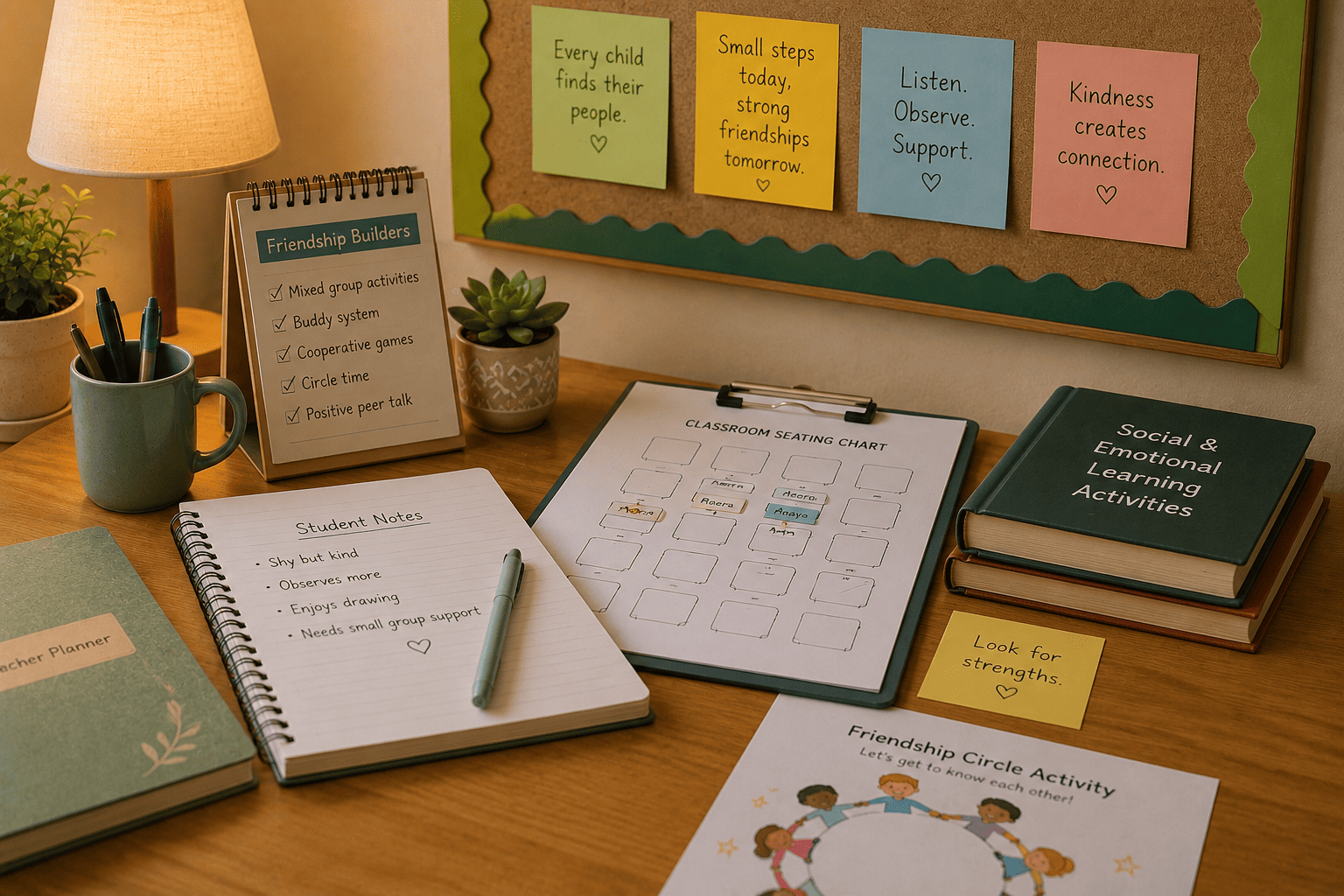
Deliberate seating and grouping choices. Thoughtful teachers sometimes use seating arrangements or small-group activities specifically to create low-pressure opportunities for a quieter child to connect with a classmate who might be a good match temperamentally.
Structured cooperative activities, particularly in the early years, that require paired or small-group interaction as part of the normal curriculum, rather than leaving all social interaction to unstructured, higher-pressure free-play time.
Active supervision during break and lunch times, with staff genuinely watching for children who seem isolated or excluded, rather than treating break time purely as unsupervised downtime.
A willingness to gently, specifically intervene when a pattern of exclusion or difficulty is noticed, rather than waiting for a parent to raise it first.
Programs that build social-emotional skills directly, teaching things like how to join a group activity, how to handle a disagreement, or how to read a peer’s body language, as genuine skills rather than assuming every child picks these up naturally on their own.
What You Can Do at Home
Facilitate small, low-pressure connections outside school. A single playdate with one specific classmate, in a quieter, more controlled setting than a busy classroom or playground, often does more for building a real friendship than hoping it develops naturally in a larger group.
Practice social scripts in low-stakes ways. For a child who genuinely doesn’t know how to join a group or start a conversation, simple, practiced phrases — “can I play too?” or “what are you building?” — give them a concrete tool to use, rather than leaving them to figure out the right approach in the moment under social pressure.
Avoid over-narrating the problem in front of your child. Discussing your worry about their friendships within earshot, even if not directly to them, can inadvertently signal that something is wrong with them, which tends to increase anxiety rather than build confidence.
Celebrate small wins specifically. If your child mentions playing with someone new, even briefly, respond with genuine, specific enthusiasm rather than moving straight to “are you going to play with them again,” which can turn a small positive moment into pressure.
A Real Scenario Worth Recognising
Consider a common pattern: a Grade 2 child, previously fairly social, starts becoming noticeably quieter and more withdrawn around a specific classmate she used to play with regularly, though she can’t or won’t explain exactly why.
Rather than assuming the worst or dismissing it as a passing phase, this is a good moment for a specific, curious conversation, both at home and with the teacher, about what might have shifted in that particular friendship. Sometimes it’s something as simple as a new friend entering the group and temporarily disrupting the previous dynamic; sometimes it reflects a specific unresolved disagreement neither child has the words to fully explain yet.
Teachers, watching this play out daily in the classroom and at break time, are often able to gently facilitate a resolution — a structured paired activity, a quiet word to both children — far more effectively than a parent trying to manage a friendship dynamic entirely from the outside, without visibility into what’s actually happening day to day.
Helping a Child Who Has Recently Moved Schools Build New Friendships
Children who’ve recently transferred schools, whether mid-year or at the start of a new academic year, face a particular version of this challenge: building entirely new social connections from scratch, often while an established friend group among their new classmates already exists.
This is worth extra patience and support, since it’s genuinely harder than joining a fresh cohort where everyone is meeting each other for the first time simultaneously. Ask the receiving school specifically whether they have any structured buddy system for new students, and consider proactively arranging a low-pressure outside-school interaction with one or two specific classmates the teacher identifies as a potential good match.
Give this process real time before drawing conclusions. Building genuine friendship in an already-established social environment often takes longer than the first few weeks, even for a naturally sociable child, and this is completely normal rather than a sign that something is wrong.
Building Your Child’s Own Toolkit for Social Situations
Beyond what happens at school, there’s real value in helping your child build a small, practical toolkit of social skills they can draw on independently, rather than relying entirely on adult intervention every time a difficulty arises.
This might include simple strategies like how to politely ask to join an activity already in progress, how to suggest an alternative if a first idea doesn’t work out, or how to recognise when a peer needs some space rather than taking a moment of quiet from a friend personally.
These are skills, not innate traits, and like any skill, they improve with gentle, low-pressure practice over time rather than emerging fully formed on their own.
When to Seek Additional Support
For most children, social struggles ease with time, gentle support, and the right structured opportunities. But it’s worth knowing when a pattern might benefit from additional, more specialised support.
If social difficulty is persistent over many months despite genuine effort from both home and school, if it’s accompanied by significant anxiety or reluctance to attend school at all, or if a teacher notices patterns that seem to go beyond typical shyness — difficulty reading social cues consistently, for instance — it’s worth discussing with your pediatrician, who can advise on whether further evaluation might be helpful.
This isn’t about jumping to conclusions or labelling a child prematurely. It’s about recognising that genuine, persistent struggle sometimes benefits from more targeted support than time and general encouragement alone can provide.
Why Class Size and Structure Genuinely Matter Here
This is worth naming directly, since it’s often overlooked in broader school evaluation conversations: a smaller, more stable class grouping generally makes it easier for a socially hesitant child to build genuine connections than a larger, more fragmented one where peer groups shift constantly across different subjects and activities.
A child who sees the same, relatively small group of classmates consistently across the day has more repeated, low-pressure opportunities to build familiarity and comfort over time, compared to a child navigating a much larger, more socially complex environment with less consistency.
What This Looks Like at a School That Takes This Seriously
Schools that treat social-emotional development as a genuine part of their curriculum, not just an informal hope that it happens naturally, tend to build specific structures around this — smaller class groupings in the early years, deliberate cooperative learning activities, and teachers trained to actively watch for and support children who seem to be struggling socially.
At Marigold International School, this reflects the broader NEP 2020-aligned approach to holistic development, where building genuine social and emotional skills is treated as seriously as academic learning, particularly in the foundational and primary years when these patterns are being established.
For families evaluating schools with this specifically in mind, it’s worth asking directly during a visit how the school supports children who seem to be struggling socially, and listening for specific, structured answers rather than a general reassurance that “children usually work it out.”
Frequently Asked Questions
Is it normal for a child to have just one or two close friends rather than a large friend group? Yes, completely normal, and often reflects a naturally introverted temperament rather than a problem. What matters more is whether your child feels genuinely content with their social connections, not the raw number of friends.
How can I tell if my child is being deliberately excluded versus simply preferring to play alone? Ask the teacher directly, since they observe these dynamics far more closely than you can from home. A pattern of your child wanting to join but being turned away is quite different from a pattern of your child choosing solitary play, and calls for different responses.
Should I intervene directly with another child’s parents if I think my child is being excluded? Generally, it’s better to raise the concern with the teacher first, who can address classroom dynamics appropriately, rather than approaching another family directly, which can sometimes escalate tension unhelpfully between children and families.
At what age do friendship patterns typically stabilise? Social dynamics continue evolving throughout childhood, though friend groups often become somewhat more stable from around Grade 3 or 4 onward, compared to the more fluid social landscape of the earliest school years.
Can a school genuinely help a shy child build confidence socially, or is this mostly something to manage at home? Both matter, but a school with deliberate social-emotional programming and attentive teachers can meaningfully support this, particularly through structured, low-pressure group activities that give a shy child repeated practice in a genuinely safe environment.
Managing Your Own Worry Without Passing It to Your Child
It’s worth acknowledging honestly that friendship struggles often trigger a parent’s own memories and anxieties around their own school-age social experiences, sometimes more intensely than the situation itself objectively calls for.
If you notice yourself feeling unusually anxious or upset about your child’s social life, it’s worth pausing to consider whether some of that reaction is genuinely about your child’s current situation, or partly about your own past experiences resurfacing. This isn’t about dismissing your concern, but about making sure your response is calibrated to what your child is actually experiencing, not amplified by something separate you’re carrying yourself.
Children are remarkably perceptive about a parent’s underlying anxiety, even when it’s never stated directly, and an overly anxious parental response can sometimes make a child more self-conscious about a struggle that might otherwise have resolved with a bit more time and a calmer, steadier kind of support.
A Final, Honest Note
Watching your child struggle socially is genuinely hard, harder in some ways than watching them struggle academically, because it touches something more personal and less straightforward to fix with a tutor or extra practice.
Most children find their way to genuine, comfortable friendships eventually, sometimes on their own timeline rather than yours. Stay curious, stay involved without overmanaging, and lean on the teachers who see your child’s daily social world far more closely than you’re able to from home.
One last practical tip: resist comparing your child’s social pace to a sibling’s or another family’s child. Some children make friends easily and quickly; others build fewer, deeper connections more slowly. Both are entirely valid paths, and the comparison rarely helps either you or your child feel better about wherever they currently are.
Is it ever appropriate to ask the teacher to specifically pair my child with another classmate? Yes, this is a completely reasonable request, particularly if you’ve identified, through conversation with your child or the teacher, a specific classmate who might be a good match. Most teachers welcome this kind of specific, actionable input, since it gives them something concrete to work with rather than a general concern to address on their own.