


Every “Top 10 Schools in South Bangalore” list you find online looks suspiciously similar.
Same five or six names, reshuffled in a different order, with the same three adjectives — “holistic,” “world-class,” “excellence” — repeated until they stop meaning anything.
This blog does something different. Instead of ranking schools by vague reputation, we compare them on the things that actually change your day-to-day life as a parent: where they are, how much space they have, what they cost, and what kind of experience your child will actually have.
South Bangalore stretches across a huge area — Jayanagar, JP Nagar, Bannerghatta Road, Bilekahalli, Konanakunte, Kanakapura Road, Uttarahalli, RR Nagar, Kengeri, and Kumbalgodu all technically fall under “south Bangalore” in most searches. But a school in Jayanagar is a completely different commute if you live near Kengeri.
So let’s break this down properly, by what parents in different pockets of south Bangalore are actually choosing between.

Why “Top Schools” Lists Are Often Misleading
Most school comparison content online is written by the schools themselves, or by directories that get paid placement.
That is not necessarily dishonest — every school has the right to describe itself well — but it does mean the “top 10” list you are reading is rarely an independent, apples-to-apples comparison.
The fairer way to compare schools is on measurable factors: campus size, board and curriculum continuity, fee range, transport coverage, and specific facilities you can verify with your own eyes on a visit.
We have used exactly that approach below.
The Main Clusters of South Bangalore School Options
Broadly, families in south Bangalore are choosing between a few types of schools:
Established city-centre brand names in areas like Jayanagar and Bannerghatta Road — often older, well-known, but working with limited land and higher fee brackets as demand has pushed prices up over the years.
Large international-format campuses further out, in areas like Bannerghatta and Kanakapura Road, that offer bigger infrastructure but come with premium pricing.
Newer, spacious campuses along the Mysore Road–Kengeri–Kumbalgodu belt, which increasingly appeal to families who want a genuine large campus and easier peak-hour access without the price tag of the more established inner-city names.
Each cluster suits a different priority. Let’s compare on the factors that matter.
Comparing on Commute Reality
If you live in Kengeri, Uttarahalli, RR Nagar, or along the Mysore Road stretch, a school in Jayanagar or JP Nagar can easily mean 45 to 60 minutes one way during school-run hours, especially with traffic near Nayandahalli and the NICE Road junctions.
That is nearly two hours a day, every day, spent purely in transit — time that could otherwise go into rest, homework support, or simply being a kid.
Schools positioned along the Kumbalgodu–Mysore Road corridor exist specifically to solve this problem for families in Kengeri, RR Nagar, Uttarahalli, and the newer residential layouts springing up along the highway.
Before comparing any two schools on reputation, run the actual commute during an 8 am weekday. The numbers often surprise parents who assumed “it’s not that far on the map.”
Comparing on Campus Size and Infrastructure
This is where the gap between schools becomes most visible, and most parents underestimate how much it matters.
A school squeezed into a multi-storey building on a compact urban plot simply cannot offer the same physical education, sports variety, or open assembly space as a school built on several acres.
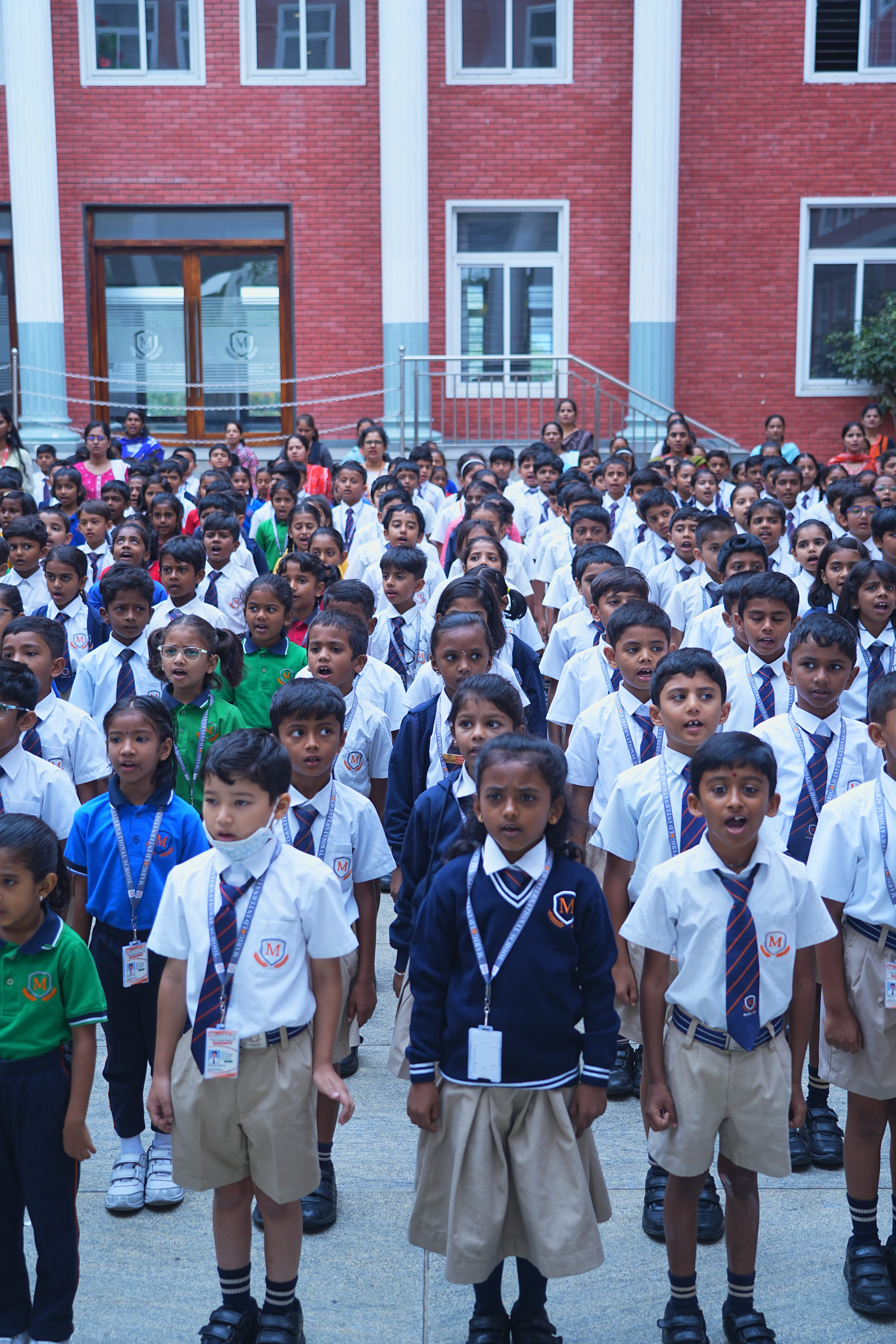
Marigold International School’s 10-acre campus in Kumbalgodu is a genuine outlier on this metric for the region — most schools within the core of south Bangalore operate on a fraction of that land, given how built-up areas like Jayanagar and JP Nagar have become.
When comparing schools, ask each one directly: how many acres, how many playgrounds, how many labs, and is there a dedicated space for younger children separate from the senior school? The answers vary far more than most parents expect.
Comparing on Board Continuity
Some schools in south Bangalore only run up to Grade 8 or 10, which means a second admission search — with all its stress — right when your child is entering the most academically critical years.
Others run continuously from Pre-Nursery or Nursery through Grade 12, meaning one admission decision covers the entire school journey.
If long-term stability matters to your family — and for most families, it does — heavily weight this factor. A school like Marigold International School, spanning Pre-Nursery to Grade 12 under CBSE, removes that mid-journey transition entirely.
Comparing on Fees
Fee ranges across south Bangalore CBSE schools vary enormously, often by two to three times for a comparable grade level, depending on brand, location, and infrastructure.
Older, established names in Jayanagar and Bannerghatta Road frequently sit at the premium end, partly reflecting brand and partly reflecting scarce urban land costs.
Newer campuses further along the Mysore Road belt, including Marigold International School, have generally positioned themselves at a more accessible range while still offering large-campus infrastructure — which is worth factoring in if budget and facilities both matter to you.
We cover exact fee ranges and hidden costs in detail in our separate South Bangalore school fees guide — it’s worth reading before you finalise any shortlist.
Comparing on Curriculum Approach
All the schools mentioned here are CBSE-affiliated, meaning the syllabus itself is standardised.
The real differentiator is how actively a school has adopted the NEP 2020 approach — competency-based learning, reduced rote memorisation, integrated arts and sports, and flexibility in subject choice at the senior level — versus schools that still teach in a fairly traditional, exam-first style regardless of what their website claims.
Ask each shortlisted school for a specific example: how does a Grade 4 science class actually run? Is it experiment-led, or textbook-and-notes led? The answer tells you more than any prospectus will.

A Practical Side-by-Side Table
| Factor | City-centre established schools (Jayanagar, Bannerghatta Rd) | Premium international-format campuses | Mysore Road–Kengeri–Kumbalgodu belt (e.g. Marigold International School) |
|---|---|---|---|
| Typical commute for Kengeri/RR Nagar/Uttarahalli families | 40–60 min peak hours | 35–55 min peak hours | 10–25 min peak hours |
| Campus size | Often compact, multi-storey | Large, but premium priced | Large (10-acre range), accessible pricing |
| Board continuity | Varies, some end earlier | Usually full Nursery–12 | Nursery–12 |
| Fee range | Premium | Highest | Moderate to accessible |
| NEP 2020 adoption | Varies by school | Usually strong | Built around NEP 2020 framework |
A Neighbourhood-by-Neighbourhood Look
Jayanagar and JP Nagar. Home to some of Bangalore’s oldest, most recognised school names. Strong legacy and alumni networks, but land constraints mean smaller playgrounds and, in many cases, waitlists that stretch across years. Fees here tend to sit at the higher end of the range.
Bannerghatta Road and Bilekahalli. A mix of established CBSE schools and newer international-format campuses. Infrastructure is generally strong, but so is the price tag, and traffic on Bannerghatta Road itself has become a genuine daily obstacle during school hours.
Kanakapura Road and Konanakunte. A fast-growing corridor with several well-regarded schools, popular with families who moved into the many new apartment complexes here over the last decade. Commute is reasonable for residents nearby, but can be a stretch from Kengeri or RR Nagar.
Uttarahalli and RR Nagar. A dense residential belt with a genuine shortage of large-campus school options within easy reach, which is why many families here look slightly further out toward the Mysore Road corridor.
Kengeri, Kumbalgodu, and the Mysore Road stretch. Historically seen as “further out,” but improved road connectivity and a wave of new, spacious campuses have made this one of the more practical choices for families across Kengeri, RR Nagar, and Uttarahalli — combining shorter real commute times with larger campuses than the inner city can offer.

Comparing Extracurricular Depth, Not Just Academic Claims
Nearly every school claims to offer “holistic development.” Very few explain what that actually looks like on a weekly timetable.
When comparing schools, ask for the actual weekly schedule for the grade your child will join. How many periods are dedicated to sports, art, music, or free play, versus core academics?
Ask whether sports facilities are shared across the whole school on a rotation, or genuinely available to your child’s grade on a regular basis. A school with one basketball court serving 1,200 students offers a very different experience from one where every grade gets dedicated ground time.
Also ask about competitive opportunities — inter-school tournaments, annual sports days, art exhibitions — since these are often where children build confidence that classroom learning alone doesn’t provide.
Comparing Technology and Digital Learning
Post-pandemic, most schools now claim “smart classrooms” and “digital learning.” The claim itself tells you very little.
Ask specifically: are smart boards used daily, or only for special demonstrations? Is there a learning management system parents can actually log into to track homework and progress? How is screen time for younger grades managed and limited?
Schools genuinely built around the NEP 2020 framework tend to treat technology as one tool among many, useful for specific concepts, but not a replacement for hands-on, experiential learning, especially for children under ten.
Questions Worth Asking Every School on Your Shortlist
Bring this exact list to every campus visit, and write down the answers immediately afterward while they’re fresh:
- What is the actual student-to-teacher ratio in the grade my child will join?
- How many acres is the campus, and how much of that is usable outdoor space for children?
- What does a typical week look like for sports, art, and free play at this age?
- What is the full first-year cost, including transport, uniforms, and any one-time fees?
- Does the school run through Grade 12, or will we need to search again later?
- How is safety managed — transport tracking, campus access, emergency medical care?
- Can I speak with two or three current parents directly?
A school that answers all seven clearly and specifically, without deflecting, has already told you a lot about how it operates.
What Parents Are Actually Choosing in 2026
Talking to families across Kengeri, RR Nagar, and Uttarahalli this admission cycle, the trend is fairly clear: a growing number of parents are choosing not to default to the “famous” city-centre name simply out of habit.
Instead, they are weighing commute time and campus quality far more heavily than they did five years ago — partly because Bangalore’s traffic has only gotten worse, and partly because more genuinely good large-campus options have opened up along the Mysore Road corridor.
It is a healthy shift. A shorter commute and a bigger, greener campus are not consolation prizes. For a growing child, they are often the better choice outright.
Why the Comparison Shouldn’t Stop After Year One
A school that looks perfect for Nursery admission can feel very different by the time your child reaches Grade 6 or 7.
Class sizes sometimes grow. Facilities that felt spacious for 200 students can feel cramped once enrolment triples over a decade. Fee increases that seemed minor in year one compound significantly by year eight.
When comparing schools, ask specifically how enrolment and campus capacity are planned for the next five to ten years, not just how things look today.
A school with a genuinely large campus, like Marigold International School’s 10 acres in Kumbalgodu, has more physical room to grow into without compromising the space each child gets, which is worth factoring into a decision you are making for over a decade, not just this admission cycle.
How to Use This Comparison
Do not treat this as a final ranking. Treat it as a starting filter.
Shortlist two schools from your nearest cluster, visit both in person, and run them through the fuller checklist in our companion guide on choosing the best CBSE school in south Bangalore.
If you are based near Kengeri, Kumbalgodu, RR Nagar, or Uttarahalli and want to see what a genuinely large campus looks like up close, Marigold International School welcomes visits — walk the 10 acres yourself before deciding.
A Final, Honest Note
Comparison content, ours included, can only take you so far. It narrows the field and sharpens your questions, but the actual decision should always rest on what you see and feel walking the campus yourself.
Treat every number and claim above as a starting point for your own verification, not a substitute for it.
Frequently Asked Questions
Is a school further away but more “famous” worth the longer commute? Only you can weigh that trade-off, but be honest about the real daily time cost, not the map distance. A tired child spending two extra hours a day commuting is a real cost, not a hypothetical one.
Do bigger campuses always mean better academics? Not directly, but they consistently mean better physical education, more varied extracurriculars, and a calmer daily environment — all of which support academic performance indirectly.
How many schools should I shortlist before deciding? Two to four is realistic. Fewer, and you risk not having a fair comparison; more, and campus visits become exhausting and start blurring together.
Should I trust online “top school” rankings? Use them only as a starting list of names, never as the final word. Verify every claim on an actual visit, and prioritise sources that explain their comparison method over ones that just list adjectives.
What’s the single most overlooked factor when comparing schools in south Bangalore? Realistic daily commute time during actual peak traffic. Parents consistently underestimate this until they’ve lived it for a full term.
Is it fair to compare an established Jayanagar school with a newer Kengeri-area campus? Yes, as long as you compare them on the same measurable factors — commute, campus size, fees, continuity, and safety — rather than assuming age or brand automatically wins. A newer school with a larger campus can genuinely out-perform an older, cramped one on the factors that affect your child daily.
How much weight should fees carry in the final decision? Enough to be realistic about affordability over 12 years, but not so much that it overrides fit. A slightly higher fee for meaningfully better campus space, safety, and continuity is often worth it; paying a premium purely for a brand name often isn’t.
One last practical tip: print or save this comparison table, take it with you on every campus visit, and fill in your own live observations next to each column. A comparison built from what you actually witnessed will always beat one built from marketing copy alone.
And a second tip worth repeating to every parent starting this search: don’t let the first two or three schools you visit anchor your expectations too early. It’s natural to compare every subsequent school to your first impression, but campus tours often improve at reading what parents want to hear as the season goes on. Keep your own written notes from each visit, made on the spot, before opinions from other parents or later tours start to blur your memory of what you actually saw.